Journal of caring sciences. 14(2):80-85.
doi: 10.34172/jcs.025.33341
Original Article
Effect of Activity Therapy on Self-Esteem among Patients with Schizophrenia: A Randomized Controlled Trial
Delmy Paul Conceptualization, Data curation, Formal analysis, Funding acquisition, Investigation, Methodology, Project administration, Resources, Project administration, Validation, Visualization, Writing – original draft, Writing – review & editing, 1 
Rajendran Rangasamy Kavitha Conceptualization, Data curation, Formal analysis, Funding acquisition, Investigation, Methodology, Project administration, Resources, Project administration, Supervision, Validation, Visualization, Writing – original draft, Writing – review & editing, 1, *
Moushumi Purkayastha Mukherjee Conceptualization, Data curation, Formal analysis, Funding acquisition, Investigation, Methodology, Project administration, Resources, Project administration, Supervision, Validation, Visualization, Writing – original draft, Writing – review & editing, 2
KT Harichandrakumar Conceptualization, Data curation, Formal analysis, Investigation, Methodology, Project administration, Resources, Project administration, Supervision, Validation, Visualization, Writing – original draft, Writing – review & editing, 3
Author information:
1Department of Psychiatric Nursing, College of Nursing, Jawaharlal Institute of Post Graduate Medical Education and Research (JIPMER), Puducherry
2Department of Psychiatry, Jawaharlal Institute of Post Graduate Medical Education and Research (JIPMER), Puducherry
3Department of Biostatistics, Jawaharlal Institute of Post Graduate Medical Education and Research (JIPMER), Puducherry
Abstract
Introduction:
Schizophrenia is a chronic mental disorder that adversely affects patients’ self-esteem. Activity therapy has been shown to positively influence self-esteem. This study aims to examine the efficacy of activity therapy in improving self-esteem among patients with schizophrenia.
Methods:
In this randomized controlled study, 79 patients diagnosed with schizophrenia were enrolled using a consecutive sampling technique. The participants were assigned into intervention (39 participants) and control groups (40 participants) using computer-generated randomization. Researchers used The Rosenberg Self-Esteem Scale (RSES) to assess the participants’ self-esteem. The intervention group underwent activity therapy of making bags and envelopes using paper for seven days. The control group received routine psychiatric care. The post-test assessment was done using RSES after 7 and 15 days of intervention. Data was analyzed using descriptive and inferential statistics using SPSS software version 21.
Results:
The total self-esteem score at both 7 days and 15 days post-intervention were significantly higher in the intervention group compared to the control group.
Conclusion:
Evidence suggests that structured manual activities, such as the fabrication of paper bags and envelopes, may contribute to enhanced self-esteem and greater self-efficacy in patients, thereby facilitating improved psychosocial functioning. However, additional rigorous research is required to substantiate these observations.
Keywords: Activity therapy, Self-esteem, Patients with schizophrenia
Copyright and License Information
© 2025 The Author(s).
This work is published by Journal of Caring Sciences as an open access article distributed under the terms of the Creative Commons Attribution Non-Commercial License (
http://creativecommons.org/licenses/by-nc/4.0/). Non-commercial uses of the work are permitted, provided the original work is properly cited.
Funding Statement
This study received intramural funds from the Jawaharlal Institute of Postgraduate Medical Education and Research, Puducherry, India.
Introduction
Schizophrenia is characterized by disturbances in thought, perception, emotion, language, social interaction, sense of self, volition, interpersonal relationships, and psychomotor behavior that persist for at least six months.1 Globally, approximately 450 million people suffer from mental or behavioral disorders. The World Health Organization (WHO) reports that bipolar disorder, schizophrenia, alcohol use disorders, and depression are among the top six causes of disability. Thus, schizophrenia is a leading cause of global disability.2 In India, the prevalence of severe mental illness is 15-20 cases per 1000 population3 with schizophrenia exhibiting a lifetime prevalence of 0.41–1.41%.4
Antipsychotics, the first line of treatment in schizophrenia, primarily reduce dopamine activity and stabilizing patients by regulating symptoms like agitation, aggression, psychosis, and inappropriate behaviors. However, pharmacotherapy alone is insufficient; combinations of other alternative interventions are necessary for effective management of schizophrenia. In this regards, psychotherapy, vocational training, and social rehabilitation play a crucial role in the treatment of schizophrenia.5 In addition, patients with schizophrenia need fundamental life skills so that they be able to play their roles in families or community. Activity Therapy is one of the essential formally accepted treatment techniques for management of psychiatric disorders.6
Previous studies show that activity therapy has several benefits, including: reducing stress and anxiety; building confidence; enhancing socialization skills; engaging patients; and promoting self-esteem.7 Compared to other mental health conditions, patients with schizophrenia experience severe self-esteem deficits, leading to reduced quality of life, impaired psycho-social functioning, and disturbed self-esteem.8 Although limited studies have been investigated the effects of activity therapy on the self-esteem in patients with schizophrenia. These studies showed that activity therapy improves self esteem among them.9-11
Disorganized speech and behavior contribute to social isolation.12 Since medications alone cannot reduce patients’ negative symptoms and increase their self-esteem; adjuvant-like activities are essential to address the issue.13Moreover, activity therapy enhances independent living and quality of life for people with schizophrenia.14 Considering the potential effects of activity therapy on improving self-esteem in patients with schizophrenia, this study aims to examine the efficacy of activity therapy in improving self-esteem among patients with schizophrenia.
Materials and Methods
This randomised control trial (RCT) was conducted in the psychiatry units of Jawaharlal Institute of Post Graduate Medical Education and Research (JIPMER), Puducherry, Union territory of India. After obtaining approval from the Institute Ethics Committee (JIP/CON/IEC/M.Sc./2021/Psy.N/1), the Study was conducted from August 2022 to February 2023. The trial was registered with the Clinical Trial Registry of India (CTRI/2022/09/045670). Researchers obtained informed consent from all patients and their legally authorized representatives (LARs).
The sample size was estimated using a method of superiority trial for the quantitative outcome with a minimum expected clinical difference in the mean score in the level of self-esteem between the group as 2 with equal standard deviations of 3 (SD1 = SD2) at 5% level of significance (i.e. P < 0.05) and 80% power, 95% of confidence interval with effect size 1.8 The formula used for calculation is (N = 2 × (1.96 + 0.845)/2)2 × 32 = 72).15 The estimated sample size was 36 in each group. The sample size was further inflated with a 10% dropout, and the final sample size was 40 for each group.
Patients admitted to study setting were assessed for eligibility, and patients who fulfilled the inclusion criteria were enrolled in the study. The inclusion criteria were including: age 18 years or above; clinical diagnosis of schizophrenia and its sub-types as per ICD-10 criteria; the ability for speaking Tamil or English. Patients with chronic physical illness or disabilities, and patients with the dual diagnosis were excluded from the study. Then, the researchers explained the study’s aim, risks and benefits to the patients and their family members in English and vernacular languages. Afterward, oral and written informed consent were obtained from all patients and their LARs. Anonymity and confidentiality were maintained throughout the study and afterwards.
The random sequence was generated using the block randomization technique. A computer-generated random sequence was generated by the statistician and used to randomize the patients. The sequentially numbered opaque sealed envelope (SNOSE) technique allocated participants to the study and control groups. In first contact of main researcher with patients, the covers were opened, and the patients were allotted to each arm according to the group name written on the cover. Thirty-nine patients were randomized to the study group and 40 to the control group.
Demographic and clinical characteristics of participants were collected from their medical records or their family members. A pretest scores for self-esteem in two groups was assessed using the Rosenberg Self-Esteem scale (RSES). RSES is a public domain scale validated previously in the Indian population. RSES comprised 10 items, with respondents answering on a four-point scale ranging from strong agreement to strong disagreement. In five items (1, 2, 4, 6, and 7) scores from 3 to 0 are assigned to the items from “Strongly Agree” to “Strongly Disagree”, respectively. In the other five items, scoring is done in reverse. So, the final score ranges from 0-30. Scores between 15 and 25 are within the normal range; scores below 15 suggest low self-esteem.9 RSES was validated and well accepted in Indian population for cutoff score and reliability. RSES reliability and validity are well-received across many languages. RSES has Cronbach’s α of 0.82, minimum coefficient of reproducibility was at least 0.90.16-19The control group received routine treatment, including medications and standard ward routines. On the other hand, the intervention group received activity therapy. This technique is employed to overcome physical addictions or emotional issues, such as chronic low self-esteem. In the current research, the researcher provided activity therapy by offering materials for making paper bags, paper covers, and paper folders. The main researcher demonstrated the activity therapy to the intervention group. Then, participants performed activity therapy supervised by the main researcher for at least seven days in one-to-one or small group (1-3 patients) sessions along with routine care. The main researcher reduced the contamination bias by separating the control and intervention groups. Interventions were given to each intervention subject by physically separating them into a room kept only for rehabilitation activities. Strict instruction was given to each individual in the intervention group not to discuss their treatment details with others; separate session registers were maintained for participants to avoid contamination and overlapping of information. Intervention sessions were conducted for 45 minutes, twice a day in the morning and evening, with the participants’ agreement, for 7 days. On days 7 and 15 after intervention in the intervention group, the participants’ self-esteem was assessed using RSES.
Data were analyzed using IBM SPSS version 21. Descriptive statistics (Frequency, proportion, mean, and standard deviation) were used to describe the demographic variables and participants’ self-esteem. The chi-square test and independent samples t-tests were used to compare variables between groups. A comparison of the total self-esteem score at different time points in each study group was made using one-way repeated measures ANOVA. Two-way repeated measures ANOVA was used to compare the changes in the total self-esteem score over time between groups. Comparison of self-esteem within groups are based on paired sample t test. Independent samples t-tests and ANOVA were used to identify the association of baseline levels of self-esteem with different socio-demographic and clinical characteristics. The significance level in all tests was considered less than 0.05.
Results
Of the 80 randomized participants, one in the intervention group declined to participate in the study, resulting in a final sample of 39 participants in the intervention group and 40 participants in the control group (Figure 1). Among them, 37 (46.8%) were males and the mean age of participants was 30.5 ( ± 8.7) years. The frequency distribution of participants in the two groups and based on sociodemographic characteristics and clinical characteristics is reported in Tables 1 and 2. In addition, the results of chi-square test was showed that there were no statistical differences between groups based on these characteristics (Tables 1 and 2).
Comparison of age, family income and age of onset of illness between control and intervention groups is presented in Table 3. It showed control and intervention group were comparable at baseline.
Comparing the total self-esteem score at baseline between groups showed that the mean (SD) of self-esteem was 12.4 (3.28) and 13.28 (4.186) for control and intervention groups respectively. Independent samples t-test showed no statistical differences in this regards (P > 0.05).
The results of one-way repeated measures one-way ANOVA test showed that within control and intervention groups, statistically significant increase occurred in self-esteem levels from day 1 to day 15 (P < 0.05). However, the extent of these changes was greater in the intervention group (13.1 to 26.05) compared to control group (12 to 14.9) (Table 4). In addition, the results of the independent samples t-test showed that there was a statistically significant difference between the intervention and control groups in terms of self-esteem scores on days 7 and 15 after the intervention (Table 4). In addition, the results of the two-way repeated measures ANOVA test showed that there was a statistically significant difference between groups regarding changes in self –esteem score from baseline to day 15 scores, and the intervention group obtained higher positive change (Table 4).
Discussion
This randomized controlled trial included 79 patients with schizophrenia to examine the efficacy of activity therapy in improving self-esteem among patients with schizophrenia. The results showed that participants in both groups had low self-esteem at the baseline. This finding is consistent with a study examining self-esteem and symptoms in American individuals at high risk for psychosis. That study concluded that low self-esteem is prevalent among schizophrenia patients.20 In this regards, the Global Burden of Disease survey reported significantly low self-esteem in patients schizophrenia.8Also,a meta-analysis found that low self-esteem is common among patients with psychosis.21The findings of another study indicated that even during the stabilised period, two-thirds of psychotic patients present clinically low self-esteem.22 Most interesting finding of present study is that the participants’ mean age was 30 years. Onset of chronic illnesses with young age reduces self-esteem.23
The total self-esteem score 7 days and 15 days after intervention was significantly higher in intervention group compared to control group, demonstrating the effectiveness of the activity therapy in this population. These findings are consistent with an Indian study conducted on schizophrenia female patients, where 76.7% of participants reported improvement in their self-esteem post-intervention.24Otherprevious studies on schizophrenia and women shed light on the importance of activity therapy on quality of life and self-esteem.9,11 In result, activity therapy is effective in enhancement of self-esteem.Similarly, a quasi-experimental pre-test/post-test study showeda significant improvement in self-esteem levels between pre- and post-test scores after activity therapy.25 On other hand, prior research indicates that physical activity-based interventions reduce depression and anxiety.26 Thereby, activity therapy is successful in increasing the level of self-esteem in patients with schizophrenia.
Low self-esteem in schizophrenia is common and significantly affects the patients’ recovery. Focusing on self-care, practising self-compassion, and challenging negative thoughts are essential to improve low self-esteem. Through simple activity therapy, health care providers are able to enhance patients’ self-esteem. In present study, simple activity therapy significantly increase self-esteem between the two groups at various intervals. Based on the results mentioned above, the study’s hypothesis that activity therapy is effective in improving self-esteem among patients with schizophrenia was approved.
The findings of present study showed be used by considering its limitations. This study was conducted in a single centre on patients with a single diagnosis. In addition, the researchers didn’t examine the possibility of the long-term effect of the intervention on the symptoms and recovery of patients with schizophrenia. Further study can be done on a multicenter level with long-term follow-up to measure the symptomatic outcome of activity therapy benefits on patients with schizophrenia.
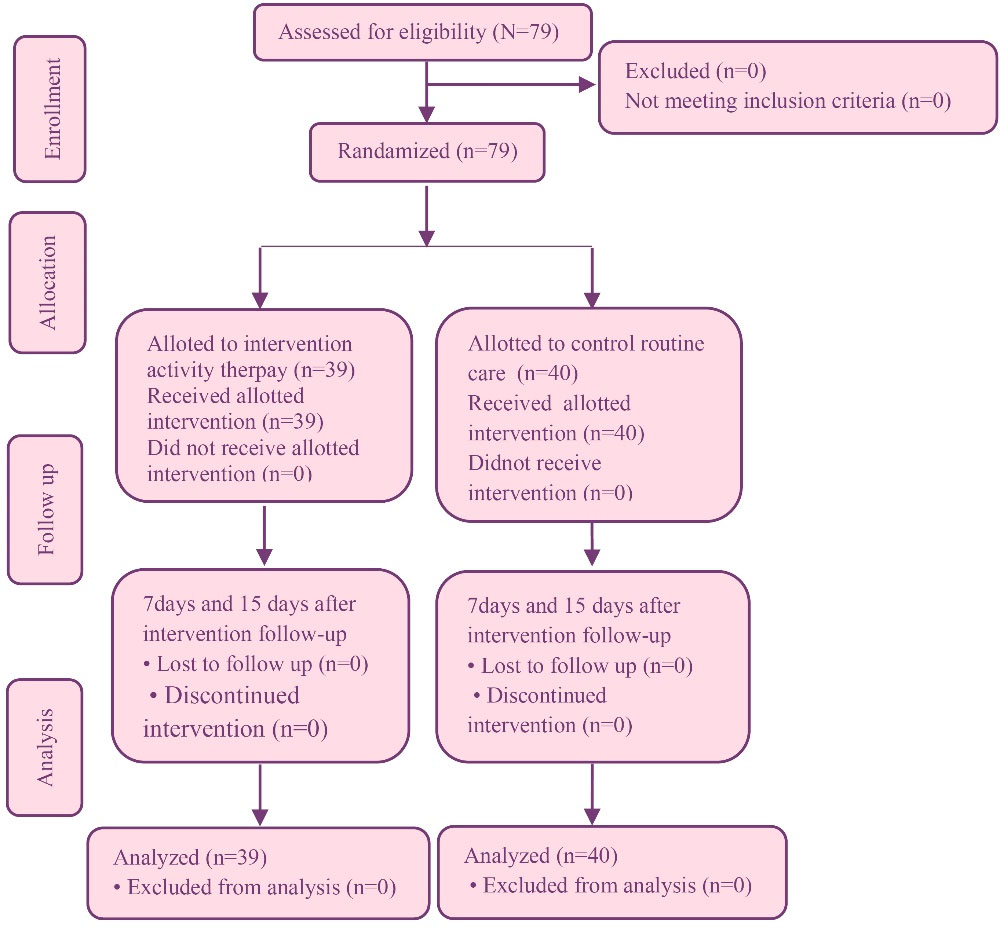
Figure 1.
Consort diagram
.
Consort diagram
Table 1.
Comparison of baseline socio-demographic characteristics between the study groups (N = 79)
|
Variable
|
N (%)
|
P
value
a
|
|
Control
|
Intervention
|
| Sex |
|
|
|
| Male |
18 (45) |
19 (48.71) |
0.74 |
| Female |
22 (55) |
20 (51.29) |
| Living status |
|
|
|
| Living with family |
40 (100) |
38 (97.43) |
0.49 |
| Living alone |
0 (0) |
1 (2.57) |
| Education |
|
|
|
| Illiterate |
5 (12.5) |
6 (15.39) |
0.09 |
| High school |
21 (52.5) |
11 (28.20) |
| Graduate |
12 (30) |
15 (38.46) |
| Postgraduate |
2 (5) |
7 (17.94) |
| Occupation |
|
|
|
| Employed |
7 (17.5) |
6 (15.39) |
0.81 |
| Unemployed |
32 (80) |
31 (77.5) |
| Student |
1 (2.5) |
2 (5.1) |
| Marital status |
|
|
|
| Single |
17 (17) |
26 (66.66) |
0.39 |
| Married |
19 (47) |
8 (20.51) |
| Divorced |
4 (10) |
5 (12.83) |
aChi-Square test; N = frequency.
Table 2.
Comparison of clinical characteristics between the study groups (N = 79)
|
Variable
|
N (%)
|
P
value
a
|
|
Control
|
Intervention
|
| Clinical diagnosis |
|
|
|
| Schizophrenia |
33(82.5) |
28 (70) |
0.32 |
| Paranoid |
0 |
3 (7.5) |
| Catatonic |
6(15) |
7 (17.94) |
| Schizoaffective |
1(2.5) |
1 (2.57) |
| Number of psychiatric admission |
|
|
|
| Only one time |
9 (22.5) |
14 (35.89) |
0.13 |
| Twice admitted |
8 (20) |
6 (15.39) |
| Three admission |
6 (15) |
5 (12.83) |
| Four admission |
2 (5) |
7 (17.94) |
| Five or more admission |
15 (37.5) |
7 (17.95) |
| Comorbid physical illness |
|
|
|
| Yes |
0 (0) |
1 (2.56) |
0.49 |
| No |
40 (100) |
38 (97.44) |
| Family history of psychiatric illness |
| Yes |
9 (22.5) |
12 (30.76) |
0.41 |
| No |
31 (77.5) |
27 (69.24) |
| Past psychiatric history |
|
|
|
| Yes |
25 (62.5) |
28 (71.79) |
0.38 |
| No |
15 (37.5) |
11 (28.21) |
aChi-Square test; N = frequency.
Table 3.
Comparison of baseline quantitative characteristics between the study groups (N = 79)
|
Variable
|
Mean(SD)
|
P
value
|
| Age |
|
|
| Control (n = 40) |
31.88 (8.72) |
0.15 |
| Intervention (n = 39) |
29.15 (7.91) |
| Family income |
|
|
| Control (n = 40) |
6675.0 (4548.25) |
0.25 |
| Intervention (n = 39) |
9897.4 (16582.79) |
| Age of onset |
|
|
| Control (n = 40) |
25.3 (7.23) |
0.24 |
| Intervention (n = 39) |
23.36 (7.44) |
Statistical test: Independent student’s t-test.
Table 4.
Comparison of the change in a total score of self-esteem over time between the study groups (N = 79)
|
Group
|
Mean (SD)
|
F value
a
(df)
|
P
value
|
|
Baseline of SE
|
After seven days, SE
|
After 15 days, SE
|
| Control (n = 40) |
12.4 (3.28) |
14.08 (2.74) |
14.9 (2.57) |
4054 (1) |
< 0.05* |
| Intervention (n = 39) |
13.16 (4.17) |
22.11 (2.95) |
26.05 (3.08) |
Conclusion
Patients with schizophrenia frequently experience chronically low self-esteem and excessive dependency, which often leads to unemployment, social isolation, and stigma. Activity therapy has proven to be an effective adjunct to standard treatment, particularly when initiated post-stabilization. The present study demonstrates that even basic activity-based interventions—such as crafting paper products—significantly enhance self-esteem among hospitalized schizophrenia patients in a South Indian Union Territory hospital. Given these findings, integrating structured activity therapy into routine psychiatric care is strongly recommended.
Acknowledgements
The authors would like to express their gratitude to all patients with schizophrenia who participated in the study.
Competing Interests
The authors declare no conflict of interest in this study.
Data Availability Statement
The datasets are available from the corresponding author upon reasonable request.
Ethical Approval
Ethical Approval Permission was obtained from the Institute Ethics Committee for Human Studies (JIP/CON/IEC/M.Sc./2021/Psy.N/1). The study was registered under the Clinical Trial Registry India (CTRI/2022/09/045670). The procedures followed were based on the institution’s ethical standards, and the Declaration of Helsinki was revised in 2013. Informed consent was obtained from patients and LARs. Data confidentiality, the subjects’ anonymity, and the right to withdraw from the study were explained to participants before data collection.
Research Highlights
What is the current knowledge?
What is new here?
-
Patients with schizophrenia are most likely to suffer from low self-esteem.
-
Activity therapy improves self-esteem in schizophrenic patients.
-
Activity therapy is a simple strategy that can be done at the bedside or at home and can be added to treatment plans for schizophrenia.
References
- Valle R. Schizophrenia in ICD-11: comparison of ICD-10 and DSM-5. Rev Psiquiatr Salud Ment (Engl Ed) 2020; 13(2):95-104. doi: 10.1016/j.rpsm.2020.01.001 [Crossref] [ Google Scholar]
- World Health Organization (WHO), Non-Communicable Disease and Mental Health Cluster. Investing in Mental Health [Internet]. Geneva: WHO; 2003. Available from: http://www.myilibrary.com?id = 9723. Accessed December 3, 2021.
- Kumar S, Mohanty S. Factors associated with self-esteem in patients with chronic schizophrenia. SIS J Proj Psychol Ment Health 2016; 23(1):56-60. [ Google Scholar]
- Hegde PR, Nirisha LP, Basavarajappa C, Suhas S, Kumar CN, Benegal V. Schizophrenia spectrum disorders in India: a population-based study. Indian J Psychiatry 2023; 65(12):1223-9. doi: 10.4103/indianjpsychiatry.indianjpsychiatry_836_23 [Crossref] [ Google Scholar]
- Patel KR, Cherian J, Gohil K, Atkinson D. Schizophrenia: overview and treatment options. P T 2014; 39(9):638-45. [ Google Scholar]
- Vita A, Barlati S, Sacchetti E. Non-pharmacological strategies to enhance adherence and continuity of care in schizophrenia. In: Adherence to Antipsychotics in Schizophrenia. Milano: Springer; 2014. p. 99-137. 10.1007/978-88-470-2679-7_3
- Cornerstone of Recovery. Activity Therapy is a Beneficial Recovery Tool in Both Physical and Mental Health [Internet]. Bradford: Cornerstone of Recovery; 2019. Available from: https://cornerstoneofrecovery.com/activity-therapy-a-beneficial-recovery-tool-in-both-physical-and-mental-health/. Accessed June 18, 2023.
- GBD 2019 Diseases and Injuries Collaborators. Global burden of 369 diseases and injuries in 204 countries and territories, 1990-2019: a systematic analysis for the Global Burden of Disease Study 2019. Lancet 2020; 396(10258):1204-22. doi: 10.1016/s0140-6736(20)30925-9 [Crossref] [ Google Scholar]
- Choudhary VS, Chaudhary G. Impact of activity therapy on improving the self-esteem among women with mental illness. J Pharm Res Int 2021; 33(29A):58-66. doi: 10.9734/jpri/2021/v33i29A31559 [Crossref] [ Google Scholar]
- Chang BH, Chen BW, Beckstead JW, Yang CY. Effects of a music-creation programme on the anxiety, self-esteem, and quality of life of people with severe mental illness: a quasi-experimental design. Int J Ment Health Nurs 2018; 27(3):1066-76. doi: 10.1111/inm.12414 [Crossref] [ Google Scholar]
- Hasan Alam F, Hassan N, El-Azzab SI. Effect of activity therapy on symptoms and quality of life among patients with paranoid schizophrenia. Port Said Scientific Journal of Nursing 2023; 10(2):1-28. doi: 10.21608/pssjn.2023.210237.1258 [Crossref] [ Google Scholar]
- Rahman T, Lauriello J. Schizophrenia: an overview. Focus (Am Psychiatr Publ) 2016; 14(3):300-7. doi: 10.1176/appi.focus.20160006 [Crossref] [ Google Scholar]
- Girdler SJ, Confino JE, Woesner ME. Exercise as a treatment for schizophrenia: a review. Psychopharmacol Bull 2019; 49(1):56-69. [ Google Scholar]
- Pardede JA, Ramadia A. The ability to interact with schizophrenic patients through socialization group activity therapy. Int J Contemp Med 2021; 9(1):6-11. doi: 10.37506/ijocm.v9i1.2925 [Crossref] [ Google Scholar]
- Kim JH, Choe K, Lee K. Effects of food art therapy on the self-esteem, self-expression, and social skills of persons with mental illness in community rehabilitation facilities. Healthcare (Basel) 2020; 8(4):428. doi: 10.3390/healthcare8040428 [Crossref] [ Google Scholar]
- McMullen T, Resnick B. Self-esteem among nursing assistants: reliability and validity of the Rosenberg Self-Esteem Scale. J Nurs Meas 2013; 21(2):335-44. doi: 10.1891/1061-3749.21.2.335 [Crossref] [ Google Scholar]
- Mahalakshmi B, Sivasubramanian N, Patel UY, Gnanadesigan E. Data on self-esteem among adolescents in India. Bioinformation 2023; 19(11):1086-9. doi: 10.6026/973206300191086 [Crossref] [ Google Scholar]
- Belhekar V, Vader V, Korgaonkar A, Dattakavi S. What lies at the center of Rosenberg Self-Esteem Scale? Network structure and latent structure of Rosenberg Self-Esteem Scale for Indian data. Bombay Psychologists 2019; 32:1-14. doi: 10.13140/RG.2.2.32264.88328 [Crossref] [ Google Scholar]
- Billa AL, Sukhabogi JR, Doshi D, Jummala S. Psychometric properties of the Telugu version of Rosenberg Self-Esteem Scale (RSES-T). Ann Ig 2023; 35(5):511-20. doi: 10.7416/ai.2023.2564 [Crossref] [ Google Scholar]
- Benavides C, Brucato G, Kimhy D. Self-esteem and symptoms in individuals at clinical high risk for psychosis. J Nerv Ment Dis 2018; 206(6):433-8. doi: 10.1097/nmd.0000000000000824 [Crossref] [ Google Scholar]
- Hofer A, Biedermann F, Kaufmann A, Kemmler G, Pfaffenberger NM, Yalcin-Siedentopf N. Self-esteem in stabilized individuals with chronic schizophrenia: association with residual symptoms and cognitive functioning. Eur Arch Psychiatry Clin Neurosci 2023; 273(8):1737-46. doi: 10.1007/s00406-022-01538-x [Crossref] [ Google Scholar]
- Bemrose HV, Akande IO, Cullen AE. Self-esteem in individuals at ultra-high risk for psychosis: a systematic review and meta-analysis. Early Interv Psychiatry 2021; 15(4):775-86. doi: 10.1111/eip.13034 [Crossref] [ Google Scholar]
- Chew J, Carpenter J, Haase AM. Living with epilepsy in adolescence-a qualitative study of young people’s experiences in Singapore: peer socialization, autonomy, and self-esteem. Child Care Health Dev 2019; 45(2):241-50. doi: 10.1111/cch.12648 [Crossref] [ Google Scholar]
- Murugeswari A. A Study to Assess the Effectiveness of Activity Therapy on the Level of Improving the Self Esteem Among Women with Mental Illness, Admitted at Institute of Mental Health, Kilpauk, Chennai [dissertation]. Chennai: College of Nursing Madras Medical College; 2016.
- Kanade AB. Effectiveness of activity therapy on self-esteem of patients with Schizophrenia. Sinhgad e Journal of Nursing 2014; 4(1):51-3. [ Google Scholar]
- Noetel M, Sanders T, Gallardo-Gómez D, Taylor P, Del Pozo Cruz B, van den Hoek D. Effect of exercise for depression: systematic review and network meta-analysis of randomised controlled trials. BMJ 2024; 384:e075847. doi: 10.1136/bmj-2023-075847 [Crossref] [ Google Scholar]