Journal of caring sciences. 14(4):235-243.
doi: 10.34172/jcs.025.33567
Original Article
The Effect of Topical Propolis Ointment on Severity of Episiotomy Pain and Wound Healing: A Triple-Blinded Randomized Controlled Clinical Trial
Masoumeh Rafatnia Data curation, Formal analysis, Investigation, Methodology, Writing – original draft, 1 
Solmaz Ghanbari-Homaie Conceptualization, Investigation, Methodology, Supervision, Visualization, Writing – original draft, 2, 3
Mojgan Mirghafourvand Conceptualization, Data curation, Formal analysis, Investigation, Methodology, Project administration, Supervision, Validation, Visualization, Writing – original draft, 4
Fatemeh Ebrahimi Investigation, Methodology, Supervision, Visualization, 5
Mahin Kamalifard Conceptualization, Data curation, Funding acquisition, Investigation, Methodology, Project administration, Resources, Supervision, Validation, Visualization, Writing – review & editing, 3, *
Author information:
1Student Research Committee, Faculty of Nursing and Midwifery, Tabriz University of Medical Sciences, Tabriz, Iran
2Research Center for Integrative Medicine in Aging, Aging Research Institute, Clinical Research Development Unit of Taleghani Hospital, Tabriz University of Medical Sciences, Tabriz, Iran
3Department of Midwifery, Faculty of Nursing and Midwifery Tabriz University of Medical Sciences, Tabriz, Iran
4Social Determinants of Health Research Center, Department of Midwifery, Faculty of Nursing and Midwifery Tabriz University of Medical Sciences, Tabriz, Iran
5Department of Traditional Medicine, Tabriz University of Medical Sciences, Tabriz, Iran
Abstract
Introduction:
Delayed episiotomy wound healing and its pain can culminate maternal complications. This study aimed to investigate the effect of propolis topical ointment on episiotomy pain severity (the primary outcome) and wound healing (the secondary outcome).
Methods:
This triple-blinded randomized clinical trial conducted on 72 gravid 1 and 2 women (36 in the propolis group and 36 in the placebo group), referring to Taleghani Hospital, Tabriz, Iran, from April to December 2023. The intervention group received propolis, and the control group received a placebo in the perineal area twice a day, for 10 days. The data were collected using a demographic questionnaire, REEDA scale, and the Visual Analogue Scale during the first 12 hours and on the 10±1 postpartum day. Data were analyzed using the independent t-test, Fisher’s exact test, the linear-by-linear chi-square test, and the Mann-Whitney U test. The modified intention-to-treat method was used.
Results:
The means (SDs) of the REEDA score in the propolis and placebo groups were 0.7 (0.8) and 0.7 (0.7) on the first postpartum day and 0.5 (1.0) and 0.3 (0.7) on the 10th postpartum day respectively, indicating no statistically significant difference between the two groups. The means (SDs) of the VAS score in the propolis and placebo groups were 3.7 (2.3) and 3.3 (1.6) on the first postpartum day and 2.4 (2.1) and 2.0 (1.3) on the 10th postpartum day, respectively, showing no statistically significant difference between the two groups.
Conclusion:
According to the results, propolis ointment does not increase wound healing rate or relieve episiotomy pain. Further research is recommended to confirm the study findings.
Keywords: Propolis, Pain severity, Wound healing, Episiotomy
Copyright and License Information
© 2025 The Author(s).
This work is published by Journal of Caring Sciences as an open access article distributed under the terms of the Creative Commons Attribution Non-Commercial License (
http://creativecommons.org/licenses/by-nc/4.0/). Non-commercial uses of the work are permitted, provided the original work is properly cited.
Funding Statement
This study was financially supported by Tabriz University of Medical Sciences, Tabriz, Iran (code: 70961).
Introduction
Vaginal and perineal ruptures are among the most prevalent complications of childbirth, which may occur spontaneously or as a result of episiotomy by the birth attendant.1 The World Health Organization (WHO) does not recommend the routine or free use of episiotomy for women with spontaneous vaginal childbirth, declaring that episiotomy rates should not exceed 10%.2 The episiotomy rate considerably varies between developed and low-income countries, ranging from 5% in Denmark to over 90% in some Asian countries.3The prevalence of episiotomy has been reported to be around 98% among primiparous Iranian women.4
Episiotomy heightens the likelihood of the expansion of perineal ruptures, infection risks, bleeding, pelvic floor dysfunctions, dyspareunia, rectovaginal fistulas, and hematomas. Such complications negatively influence mother-infant quality of life and relationship and also bring health system-related costs because of the lengthened duration of hospitalization.5
Episiotomy incisions will heal spontaneously without confounding factors, such as infection, within three weeks postpartum.6 The wound healing process encompasses a variety of complex, dynamic, and orderly occurrences, organized into four distinct steps: hemostasis, inflammation, proliferation, and regeneration.7 This process shows interindividual variations and is influenced by numerous factors, such as diet, stress, anxiety, obesity, age, medical disorders, infection, smoking, etc.8 Large wounds or impaired tissue viability may culminate in a delayed healing process, increasing the risk of wound complications.9 Perineal wound infection or dehiscence can cause severe short-term and long-term complications.10 Perineal wound dehiscence-related maternal complications can result in imposing financial costs on women and the healthcare system because of corrective surgery, perineal reconstruction, removal of excessive scar tissue.11 Also, worry about the consequences of postpartum perineal injury and its related complications,12 request for the next cesarean section,13 infection14 and pelvic floor dysfunction are among the factors associated with it.15
The results of a review study on chemical drugs, herbal drugs, and non-pharmacological methods indicate the effectiveness of most of the mentioned therapies in pain relief and episiotomy wound healing; however, due to the limited number of studies, poor quality of some studies, inconsistent results, and also the insufficient number of samples, it is impossible to provide a definite view regarding a specific method and to apply them clinically.16 Although pain relief using drugs may be beneficial, neonatal complications should be taken into account before use in lactating women. Hence, it is necessary to provide women with effective and safe pain management options and common medical therapeutic alternatives during the postpartum period.17
Propolis is a resin made by bees containing a mixture of bee saliva, beeswax, and secretions from various plants and trees.18 The chemical structure of the constituent polyphenols allows propolis to remove free radicals effectively, leading to skin wound healing by stimulating epithelial reconstruction,19 modulating extracellular matrix (collagen) deposition20,21 and facilitating granulation tissue formation.22 Thus, propolis’ antioxidant properties may assist in its protective effects in cutaneous diseases. Moreover, it has been reported that propolis can relieve cell damage in fibroblast cells by suppressing the production of intracellular reactive oxygen species (ROS) induced by excessive light.23 Positive impacts of propolis on diabetic foot wound healing have been reported.24 Based on the results of a study, topical application of propolis decreases bleeding and adenotonsillectomy postoperative pain and considerably improves wound healing.25
Considering the widespread use of episiotomy in Iran4 and the effects on the life of the mother and the baby as a result of the mother’s inability to breastfeed due to the pain caused by it, it is considered essential to provide suitable solutions for this problem. Global research is devoted to the study of propolis properties and its chemical composition from different geographical and climatic regions, and due to the lack of definitive results of systematic review studies, they emphasize conducting more studies to standardize the dosage and method of use.26,27
According to the searches conducted, we did not find any study that examined the effect of propolis on episiotomy healing and pain. Based on these issues, this study investigated the effect of topical ointment of propolis on pain severity (primary outcome) and wound healing (secondary outcome) of episiotomy and determined its side effects.
Materials and Methods
The present study was designed as a 2-arm parallel, triple-blinded, randomized controlled clinical trial (the participants, researchers, and data analysts were unaware of the type of intervention received). The study protocol was approved by the Ethics Committee of Tabriz University of Medical Sciences, Tabriz, Iran (code: IR.TBZMED.REC.1401.971) and registered at the Iranian Registry for Clinical Trials (IRCT) (identifier: IRCT20110524006582N37). The sample size in this study was calculated based on both variables of episiotomy pain severity and healing score using G-Power software. According to a study,28 regarding the measurement of episiotomy repair variables with the Redness, Oedema, Ecchymosis, Discharge, and Approximation (REEDA) scale and considering M1 = 1.04, M2 = 2.06, SD1 = 0.854, SD2 = 0.62, two-sided α = 0.05, and Power = 95%, the sample size was calculated to equal 15 people for each group, which considering a 10% drop, the final sample size was determined to be 17 people for each group. Furthermore, regarding the pain severity variable and considering M1 = 0.54, M2 = 1.58, SD1 = 1.21, SD2 = 1.68, two-sided α = 0.05, and Power = 80%, it was determined to be 33 people, which considering 10% drop, the final sample size was considered equal to 36 people in each group. Given that the sample size calculated based on the pain severity variable was higher, the final sample size was determined to be 36 people in each group.
The inclusion criteria included primigravida and secundigravida women living in the city of Tabriz, the mother’s willingness and possibility to refer to the sampling place on the 10th day, and vaginal childbirth with a mediolateral incision. Exclusion criteria included: prolonged rupture of the amniotic sac (more than 18 hours), taking special medicines (such as anti-inflammatory medicines and anticoagulants), alcohol or drug addiction, a history of wound-healing impairing diseases (such as systemic diseases, cardiac diseases, kidney diseases, lung diseases, coagulation disorders, immunodeficiency, connective tissue disorders, diabetes, anemia, mental illnesses and hemophilia), abnormal postpartum bleeding, preterm childbirth, allergy to propolis, large or extended episiotomy (third-degree or fourth-degree rupture and episiotomy incision length over 3-4 cm), a history of perineal surgery or visible lesions in the perineum, severe anemia (hemoglobin lower than 7 g/dL), other ruptures besides episiotomy (such as urethral rupture) and unwillingness to continue cooperation.
This research was conducted at Taleghani Educational Hospital in Tabriz, Iran, and around 40% of childbirths in this hospital are of vaginal type.
A person not involved in the study performed random assignment, numbering, and labeling of the ointments. The drug and placebo were identical in color, size, and shape. The participants, researchers, data collectors, and data analysts were unaware, and only the person determining the sequence of assigning individuals in the groups was aware of the type of prescribed drug. The researcher attended the maternity and postpartum wards of Taleghani Educational Hospital, Tabriz, Iran, identified the individuals meeting the inclusion criteria, and, after introducing herself and providing the required explanations about the research, obtained written informed consent from the individuals who were inclined to participate in the study. The sequence of allocation in the intervention groups was carried out using a computer randomization program with an allocation ratio of 1:1. In addition, stratification was implemented based on parity (the first and second parity). The demographic characteristics questionnaire was completed using the file documents and participant interviews. The length and depth of episiotomy and perineum incision were assessed regarding episiotomy extension or rupture in other areas. Pain severity was recorded using the Visual Analogue Scale (VAS) as an interview, and the healing rate was recorded using the REEDA scale after examining the episiotomy before the intervention. Propolis herbal ointment was prepared by a pharmacist specializing in a traditional pharmacy under completely hygienic and standard conditions. To do this, the propolis prepared from a reliable source was initially melted by the bain-marie method and indirect heat and filtered to eliminate impurities. Then, it was mixed with the prepared ointment foundation (prepared Eucerin) at a ratio of 7.5% at a temperature of 40 °C. The prepared ointment was stirred slowly until it cooled completely to have a uniform texture. For example, in order to prepare 100 g of propolis ointment, 7.5 g of propolis filtered from impurities was mixed with 92.5 g of prepared ointment foundation. The prepared ointment foundation was also used as a propolis-free placebo ointment. For ointment color adjustment, the allowed medicinal color was used to simulate the placebo ointment, and the propolis color and a little honey essence were used to simulate the propolis odor. It is worth mentioning that this ointment foundation contained Eucerin (Vaseline and a little lanolin), lacked any allergenic substances, and was completely hygienic and compatible with all skin types. After evaluating pain severity and healing rate before the intervention, the package containing the ointment was given to the participant. The participants were verbally trained on the ointment use instructions and the intervention process, and they were provided a pamphlet on how to care for the episiotomy incision (including recommendations on perineal hygiene, sexual relations, nutrition, and ointment use). They were also instructed to wash their hands and perineum thoroughly each time before using the ointment, wipe it with a clean towel, and then put the ointment an approximately 2-cm strip of ointment in the perineal area and repeat it twice a day, 12 hours apart ( ± 2 hours), for 10 days. In order to make sure that the participant is not allergic to propolis, skin allergy testing was performed in such a way that an amount of the ointment was first placed on the forearm, and it was checked after 15 minutes regarding reactions, such as redness, swelling, itching, and raised skin; no allergy was observed in the participants. In addition, to make sure that the participants had understood the instructions, the ointment was used for the first time by the participant about 2 hours before discharge in the presence of the researcher, and then the mother was recommended to refer to the hospital on the 10 ± 1 day after the intervention to evaluate and record the wound healing status (using the REEDA scale) and pain severity (using the VAS scale). Meanwhile, the participants were provided with twenty 500 mg Acetaminophen tablets and a notebook (to record the amount of Acetaminophen ointment and tablets given, any medicine or painkiller taken during this period, and any complications), and they were required to take the notebook and the envelope concerning the taken pills with them when referring for the visit on the 10th day. In case of reporting any side events, the participant was referred to a specialist physician. On the 10 ± 1 day, the researcher examined the participants regarding pain severity and healing rate using the VAS and the REEDA scale, respectively, during the in-person visit to the hospital.
Data collection tools included a participant demographic questionnaire, the REEDA scale, the VAS, the Satisfaction and Recovery checklist, the medication use checklist, and the drug complications checklist. The demographic characteristics questionnaire contained items such as the mother’s age, education level, husband’s education level, occupation, income level, place of residence, housing status, number of living children, and number of abortions. Formal and content validity methods were used to determine the questionnaire’s validity. For this purpose, the questionnaire was provided to 10 midwifery and reproductive health faculty members, and the necessary corrections were applied based on their feedback.
The REEDA scale consisted of five items: redness, edema, ecchymosis, discharge, and approximation of the wound edges, and each item was assigned a score between 0 and 3. The scale total score was between 0 (maximum healing) and 15 (minimum healing). A total score of zero, 1-5, 6-10, and 11-15 denoted healed tissue, moderate healed, poor healed, and not healed, respectively.29 The kappa coefficient was used in the reliability analysis of the REEDA scale by Alvarenga et al, where the discharge item (0.75 < kappa ≥ 0.88), assessment of edema (0.16 < kappa ≥ 0.46), ecchymosis (0.25 < kappa ≥ 0.42), and redness (0.46 < kappa ≥ 0.66).30 The VAS consisted of a 10-cm graduated ruler, graded from 0 (no pain) to 10 (the most severe pain possible) based on millimeters. In this tool, a score of zero denotes no pain, 1-3 denotes mild pain, 4-7 denotes moderate pain, and 8-10 denotes severe pain. The validity of this scale has previously been measured by Sabzaligol et al,31 and its reliability has also been confirmed in Iran with a correlation coefficient of 0.88.32. A 5-point scale (very satisfied, satisfied, moderately dissatisfied, dissatisfied, and very dissatisfied) was employed to assess the level of satisfaction with the medicine taken. A 5-point scale (very bad, bad, moderate, good, and very good) was also employed to assess the response rates to treatment and healing. The checklist of a history of taking medicine encompassed the first and second hours of using the ointment, the hours and days of taking Acetaminophen tablets and other drugs, and the remaining number of Acetaminophen tablets. The checklist of drug complications included itching, skin allergy, blisters, swelling, and other complications in the wound area and the healing rate, the level of satisfaction, and the cause of dissatisfaction.
The data were analyzed using SPSS statistical software version 13. In evaluating the demographic characteristics, the independent t-test was used to compare age; Fisher’s exact test was used to compare occupation, housing status, and the number of abortions; the linear-by-linear chi-square test was used for income adequacy and education level; and the chi-square test was used for the number of pregnancies, births, and living children. Furthermore, the Kolmogorov-Smirnov test was used to determine the normality of the data. According to this test, the data lacked normal distribution. The Mann-Whitney U test was also used to compare the mean score of pain and healing, the healing rate, the level of satisfaction, and the number of Acetaminophen taken among the study groups. In this study, the modified intention-to-treat method was used. The level of statistical significance was set at P < 0.05.
Results
In this study, sampling was performed between April and December 2023. A total of 140 people were evaluated in terms of eligibility; 59 of them were not included in the study because of not meeting the inclusion criteria (14 people due to being gravid 3 and above, 11 people due to not living in the city of Tabriz, 21 people due to having a cesarean section, 3 people due to a ruptured amniotic sac for more than 18 hours, 3 people due to not being able to visit the hospital on the 10th day, 2 people due to taking magnesium sulfate for preeclampsia, 4 people due to preterm childbirth, and 1 person due to a large episiotomy), and 9 people were not included because of their unwillingness to participate in the study. Finally, 72 patients were entered into the study. The participants were then divided into propolis ointment and placebo groups. During the study, 2 people in the propolis group and 2 in the placebo group discontinued the use of propolis ointment and placebo due to side effects, however, questionnaires and checklists were completed for all 72 participants. Finally, 72 participants (36 in the propolis group and 36 in the placebo group) were investigated (Figure 1).
In this research, the analysis was based on intention-to-treat and was based on the consortium statement. The means (SDs) of age in the propolis and placebo groups were 24.2 (5.3) and 26.2 (5.7) years, respectively. No statistically significant difference was observed between the two groups regarding demographic and obstetric characteristics (P > 0.05) (Table 1). The mean (SD) of the REEDA score in the propolis and placebo groups was 0.7 (0.8) and 0.7 (0.7) on the first day and 0.5 (1.0) and 0.3 (0.7) on the 10th day, respectively; there was no statistically significant difference in the healing rate between the two groups before (P = 0.912) and after (P = 0.413) the intervention. The mean (SD) of the VAS score in the propolis and placebo groups was 3.7 (2.3) and 3.3 (1.6) on the first day and 2.4 (2.1) and 2.0 (1.3) on the 10th day, respectively; there was no statistically significant difference in the pain perception between the two groups before (P = 0.568) and after (P = 0.573) the intervention. The mean (SD) of the acetaminophen tablets taken in the propolis and placebo groups was 7.9 (4.4) and 8.4(4.0) respectively. The mean (SD) of the Diclofenac suppositories used in the propolis and placebo groups was 5.3 (4.0) and 5.3 (3.7) respectively (Table 2).
In the propolis-receiving group, 26 (72.3%) people were very satisfied and satisfied with the ointment, and in the control group, 25 (69.4%) were very satisfied and satisfied, which according to the Mann-Whitney U test, no significant difference was found between the two groups regarding the level of satisfaction with the drug taken (P = 0.780); 25 people in the propolis group (69.5%) and 29 in the control group (80.5%) reported the healing rate as good and very good. There was no significant difference between the investigated groups regarding the rate of response to treatment (P = 0.113) (Table 3). Concerning complications, in the placebo group, 2 people (5.6%) had itching and 4 (11.1%) had sting; in the placebo group, 1 (2.8%) reported itching, 1 (2.8%) reported skin allergy, 1 (2.8%) reported skin allergy + swelling, and 1 (2.8%) reported skin allergy + sting.
Discussion
This research was designed to investigate the effect of propolis ointment on episiotomy pain severity and healing rate. No significant difference was observed between the propolis ointment-receiving and placebo groups regarding episiotomy healing rate and pain severity at the end of the intervention.
Moon et al’s study on 130 patients undergoing adenotonsillectomy indicated that topical propolis prepared with ten drops in 150 ml of water affected the wound healing process after tonsillectomy.25 Mujica et al’s study also demonstrated that topical propolis improved wound healing in patients with diabetic foot ulcers. However, conducting studies with longer treatment duration and follow-up was recommended to support the results and clarify the optimal dose and duration to achieve maximum treatment effectiveness.24 These findings support the idea of our study to use Topical Propolis Ointment after episiotomy as an agent for wound healing and pain relief.
Following the results of several animal studies, propolis’s positive impact on wound healing and pain relief has been demonstrated. For example, Olczyk et al. indicated that propolis remedied type I and III collagen accumulation in the burned tissue matrix by inducing burn wounds in pigs. The results provided in this study approved the propolis therapeutic efficacy, which was associated with inducing a desirable biochemical environment to support the wound healing process.32 In Barroso et al’s study, the propolis ethanolic extract used at a dose of 0.5 ml, compared to Dexamethasone, led to a greater reduction in the number of mast cells in the edge and central area of the circular surgical wound created on the back of the tongue of 90 hamsters.33 Da Silva Barud et al indicated that an ethanolic extract of Brazilian antimicrobial propolis (EPP-AF) with a dose of 0.5 mg contained biocellulosic membranes as a promising biomaterial for healing cutaneous wounds of 24 male rats weighing about 250 g.34
Although the results of this study demonstrated the sameness of the episiotomy healing process in the group receiving propolis ointment compared to the group receiving placebo, this finding matches the findings of some studies conducted on the effect of propolis on wound healing. In this regard, Kavaz et al’s study revealed that 100 g of raw propolis mixed with 1.900 mL of 70% ethanol had no significant effect on mucosal wound healing after endoscopic nasal surgery in a rabbit model.35 The results of a trial conducted by Jacob et al to assess and compare the impacts of ethanolic extracts of Malaysian propolis and Brazilian red propolis in various concentrations on the migration and proliferation of fibroblast cells indicated that Malaysian and Brazilian red propolis had the potential to contribute to wound healing, depending on their concentrations.36 Ebadi and Fazeli’s research evaluating the potential effects of propolis and honey in laboratory conditions on wound healing in human skin fibroblast cells demonstrated that samples of Iranian propolis and honey effectively influenced the migration, proliferation, and survival of human dermis fibroblast cells in a dose-dependent manner.37 Unlike the results obtained in the present study, in the majority of the studies mentioned above, propolis contributes to the healing rate and pain relief. One of the reasons for the discrepant results can be the dosage of drugs. Since there are variations in the propolis chemical structure and no standard has been achieved yet, the therapeutic or toxic doses are not completely known for humans and animals.36 We used propolis with a dose of 7.5 g to prepare a 100 g ointment in our study. On the other hand, multiple factors, including plant origin of resin, bee genetics, hive structure, food accessibility, environmental factors, and disease, can impact the production of propolis.38 Therefore, another reason for the discrepant results is propolis’s biological properties, which depend on chemical composition, plant sources, geographical region, and seasons. More than 300 compounds have been identified in propolis: phenolic compounds, aromatic acids, essences, waxes, and amino acids.39 Pain is a subjective and extremely personal experience characterized by considerable interindividual diversity.40Numerous biological and psychosocial variables, including demographic variables,41 genetic factors,42 and psychosocial processes,43 contribute to creating these individual differences in pain, culminating in participants’ different perceptions of their levels of pain and satisfaction.
In the literature review, no similar research was found on the effect of propolis ointment on episiotomy wounds, and the present research was the first study completely investigating the effectiveness of the topical form of this substance on episiotomy wounds in a controlled clinical trial. Although a large number of studies have indicated the positive effects of propolis on wound healing, such an effect was not observed in this study. The current research is apparently a unique experimental study that can be used as a source for future similar studies with a higher number of subjects and higher doses of propolis.
The strengths of this study were being triple-blinded and controlling the entrance of confounding variables at the onset of sampling. One of the limitations of this study is the inability to control all factors influencing wound healing, including different individual immune systems. Moreover, since pain perception and expression vary in different individuals, they may influence the results; however, we tried to reduce the difference in pain severity measurement among the samples by using a standard pain recording ruler, blinding, and random allocation. Other limitations were possible non-adherence to ointment use, single-center sampling, and possible confounding factors from other analgesics, which we attempted to control by reporting and comparing the number of common analgesics used in the two groups.
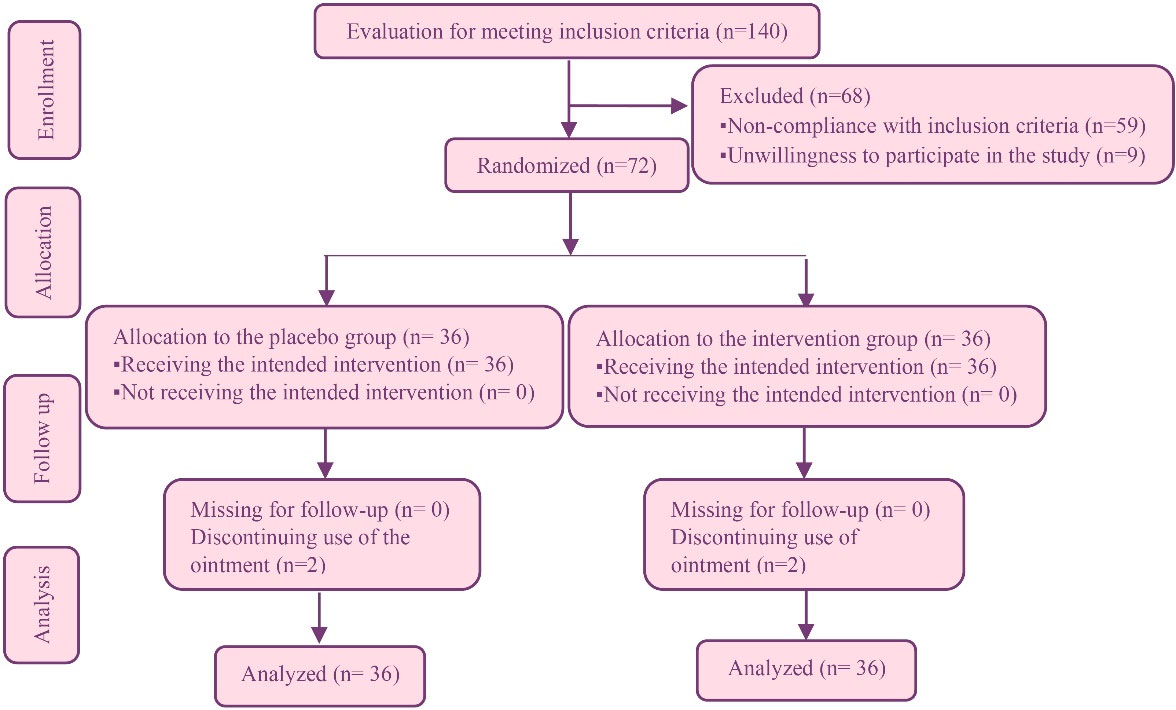
Figure 1.
Flow diagram of the effect of propolis topical ointment on episiotomy pain severity and wound healing
.
Flow diagram of the effect of propolis topical ointment on episiotomy pain severity and wound healing
Table 1.
Social demographic characteristics of mothers by study groups (n = 72)
|
Variable
|
Propolis (n=36)
|
Placebo (n=36)
|
P
value
|
| Age (year), Mean (SD) |
24.2 (5.3) |
26.2 (5.7) |
0.130a |
| Occupation, N (%) |
|
|
|
| Housewife |
35 (97.2) |
34 (94.4) |
1.000b |
| Employee |
1 (2.8) |
2 (5.6) |
| Adequacy of monthly income for living costs, N (%) |
| Quite adequate |
10 (27.8) |
12 (33.3) |
0.355c |
| Adequate |
24 (66.7) |
24 (66.7) |
| Not adequate at all |
2 (5.6) |
0 (0.0) |
| Mother’s education level, N (%) |
| Elementary |
5 (13.9) |
6 (16.7) |
0.920c |
| Guidance |
14 (38.9) |
13 (36.1) |
| High school |
6 (16.7) |
3 (8.3) |
| Diploma |
9 (25.0) |
13 (36.1) |
| Academic |
2 (5.6) |
1 (2.8) |
| Father’s education level, N (%) |
| Elementary |
2 (5.6) |
9 (25.0) |
0.329* |
| Guidance |
11 (30.6) |
8 (22.2) |
| High school |
6 (16.7) |
4 (11.1) |
| Diploma |
13 (36.1) |
9 (25.0) |
| Academic |
4 (11.1) |
6 (16.7) |
| Housing status, N (%) |
|
|
|
| Personal |
21 (58.3) |
18 (50.0) |
0.758b |
| Rental |
13 (36.1) |
15 (41.7) |
| Relatives’ house |
2 (5.6) |
3 (8.3) |
| Gravida, N (%) |
|
|
|
| 1 |
17 (47.2) |
16 (44.4) |
0.813d |
| 2 |
19 (52.8) |
20 (55.6) |
| Parity, N (%) |
|
|
|
| 1 |
20 (55.6) |
20 (55.6) |
1.000d |
| 2 |
16 (44.4) |
16 (44.4) |
| Number of living children, N (%) |
| One |
20 (55.6) |
21 (58.3) |
0.812d |
| Two |
16 (44.4) |
15 (41.7) |
| History of abortion, N (%) |
| No |
33 (91.7) |
32 (88.9) |
1.000b |
| Yes |
3 (8.3) |
4 (11.1) |
SD: Standard deviation.
aIndependent t-test ; b Fisher’s exact test;cLinear-by-linear chi-square test; dChi-square test.
Table 2.
Comparison of the mean scores of healing rate and episiotomy pain and the number of acetaminophen tablets and diclofenac suppositories consumed among the study groups (n = 72)
|
Variable
|
Propolis (n=36)
|
Placebo (n=36)
|
P
value
a
|
|
Mean (SD)
|
Median (25-75 percentile)
|
Mean (SD)
|
Median (25-75 percentile)
|
| The REEDA test (score range: 0-15) |
|
|
|
|
|
|
| Day 1 |
0.7 (0.8) |
0.0(0.0-1.0) |
0.7(0.7) |
1.0 (0.0-1.0) |
0.912 |
| Day 10 |
0.5 (1.0) |
0.0(0.0-1.0) |
0.3(0.7) |
0.0 (0.0-0.0) |
0.413 |
| The VAS test (score range: 0-10) |
|
|
|
|
|
| Day 1 |
3.7 (2.3) |
4.0 (2.0-5.0) |
3.3 (1.6) |
3.5 (2.0-5.0) |
0.568 |
| Day 10 |
2.4 (2.1) |
2.0 (2.0-3.0) |
2.0 (1.3) |
2.0 (2.7-1.2) |
0.573 |
| Acetaminophen tablets |
7.9 (4.4) |
9.0 (5.0-10.0) |
8.4 (4.0) |
9.0 (6.3-10.0) |
0.812 |
| Diclofenac suppositories |
5.3 (4.0) |
6.0 (0.3-9.8) |
5.3 (3.7) |
6.6 (1.3-8.0) |
0.995 |
SD: Standard deviation; REEDA: Redness, Edema, Ecchymosis, Discharge, Approximation.
aMann-Whitney U test.
Table 3.
The frequency of episiotomy wound healing rate and satisfaction with the drug taken by study groups (n = 72)
|
Variable
|
N (%)
|
P
value
a
|
|
Propolis (n=36)
|
Placebo (n=36)
|
| Healing rate |
|
|
|
| Poor |
4 (11.1) |
1 (2.8) |
0.113 |
| Moderate |
7 (19.4) |
6 (16.7) |
| Good |
24 (66.7) |
25 (69.4) |
| Very good |
1 (2.8) |
4 (11.1) |
| Level of satisfaction |
|
|
|
| Dissatisfied |
5 (13.9) |
3 (8.3) |
0.780 |
| Equally satisfied and dissatisfied |
5 (13.9) |
8 (22.2) |
| Satisfied |
24 (66.7) |
21 (58.3) |
| Very satisfied |
2 (5.6) |
4 (11.1) |
Conclusion
According to the present study results demonstrating that the propolis topical use has no significant effect on the pain severity and wound healing rate of episiotomy, it is suggested that the effects of this substance with biological properties, various doses and its other pharmaceutical forms on episiotomy be investigated. It is also recommended to conduct similar research in multicenter RCTs.
Competing Interests
The authors declared no conflict of interest regarding the search, compilation, or publication of this research.
Data Availability Statement
The datasets generated and/or analyzed during the present research are not publicly accessible due to ethical approval restrictions regarding patient data and anonymity, but they will be available on reasonable request from the corresponding author.
Ethical Approval
In this study, all stages implemented on human samples were in accordance with the relevant guidelines and regulations of the Declaration of Helsinki. The study protocol was approved by the Ethics Committee of Tabriz University of Medical Sciences, Tabriz, Iran (IR.TBZMED.REC.1401.971). Informed written consent was obtained from all participants, and they were fully informed of the research objectives and method. The anonymous questionnaire coding method was used to maintain confidentiality.
Research Highlights
What is the current knowledge?
-
The prevalence of episiotomy has been reported to be around 98% among primiparous Iranian women.
-
Large wounds or impaired tissue viability may culminate in a delayed healing process.
-
The complications of episiotomy negatively influence mother-fetus quality of life and relationship and also bring health system-related costs.
-
Although pain relief using drugs may be beneficial, neonatal complications should be taken into account before use in lactating women.
-
The antioxidant properties of propolis can contribute to its protective effects in skin diseases.
What is new here?
-
This is the first time that the effect of propolis topical on episiotomy wounds has been studied.
-
Demonstrating that the propolis topical use has no significant effect on the wound healing rate of episiotomy.
-
Demonstrating that the propolis topical use has no significant effect on the pain severity of episiotomy.
-
Providing a resource for future studies with a higher number of subjects and higher doses of propolis.
-
Offering evidence for targeted clinical intervention.
-
Determining the need to investigate the effect of other forms of biological propolis on episiotomy.
Acknowledgements
We would like to thank all individuals who participated in this study for their sincere cooperation, the Clinical Research Development Unit of Taleghani Hospital, Tabriz University of Medical Sciences, Tabriz, Iran, for scientific support, and Tabriz University of Medical Sciences, Tabriz, Iran, for financial support (code: 70961).
References
- Nunes RD, de Vasconcelos Mapelli A, Nazário NO, Traebert E, Seemann M, Traebert J. Evaluation of the determinant factors to episiotomy in vaginal delivery. Enferm Foco 2019; 10(1):71-5. doi: 10.21675/2357-707X.2019.v10.n1.1399 [Crossref] [ Google Scholar]
- World Health Organization (WHO). WHO Recommendations: Intrapartum Care for a Positive Childbirth Experience. WHO; 2018. Available from: https://www.who.int/publications/i/item/9789241550215.
- Clesse C, Lighezzolo-Alnot J, De Lavergne S, Hamlin S, Scheffler M. Statistical trends of episiotomy around the world: comparative systematic review of changing practices. Health Care Women Int 2018; 39(6):644-62. doi: 10.1080/07399332.2018.1445253 [Crossref] [ Google Scholar]
- Ghanbari-Homayi S, Fardiazar Z, Meedya S, Mohammad-Alizadeh-Charandabi S, Asghari-Jafarabadi M, Mohammadi E. Predictors of traumatic birth experience among a group of Iranian primipara women: a cross sectional study. BMC Pregnancy Childbirth 2019; 19(1):182. doi: 10.1186/s12884-019-2333-4 [Crossref] [ Google Scholar]
- Khan NB, Anjum N, Hoodbhoy Z, Khoso R. Episiotomy and its complications: a cross sectional study in secondary care hospital. J Pak Med Assoc 2020; 70(11):2036-8. doi: 10.5455/jpma.290331 [Crossref] [ Google Scholar]
- Cunningham FG, Leveno KJ, Dashe JS, Hoffman BL, Spong CY, Casey BM. Williams Obstetrics. 26th ed. McGraw Hill LLC; 2022.
- Enoch S, Leaper DJ. Basic science of wound healing. Surgery (Oxford) 2008; 26(2):31-7. doi: 10.1016/j.mpsur.2007.11.005 [Crossref] [ Google Scholar]
- Steen M. Perineal tears and episiotomy: how do wounds heal?. Br J Midwifery 2007; 15(5):273-80. doi: 10.12968/bjom.2007.15.5.23399 [Crossref] [ Google Scholar]
- Talas G, Brown RA, McGrouther DA. Role of phenytoin in wound healing--a wound pharmacology perspective. Biochem Pharmacol 1999; 57(10):1085-94. doi: 10.1016/s0006-2952(98)00363-3 [Crossref] [ Google Scholar]
- Deery R. Wound care and pressure ulceration in midwifery: a neglected area?. Wounds UK 2011; 7(1):10-2. [ Google Scholar]
- Ganapathy R, Bardis NS, Lamont RF. Secondary repair of the perineum following childbirth. J Obstet Gynaecol 2008; 28(6):608-13. doi: 10.1080/01443610802403401 [Crossref] [ Google Scholar]
- Pakenham S, Chamberlain SM, Smith GN. Women’s views on elective primary caesarean section. J Obstet Gynaecol Can 2006; 28(12):1089-94. doi: 10.1016/s1701-2163(16)32335-0 [Crossref] [ Google Scholar]
- Wagner M. Choosing caesarean section. Lancet 2000; 356(9242):1677-80. doi: 10.1016/s0140-6736(00)03169-x [Crossref] [ Google Scholar]
- Salmanov A, Voitok T, Maidannyk I, Vdovychenko S, Chorna O, Marushchenko Y. Episiotomy infections in the puerperium and antimicrobial resistance of responsible pathogens in Ukraine. Wiad Lek 2020; 73(11):2325-31. doi: 10.36740/WLek202011101 [Crossref] [ Google Scholar]
- Memon HU, Handa VL. Vaginal childbirth and pelvic floor disorders. Womens Health (Lond) 2013; 9(3):265-77. doi: 10.2217/whe.13.17 [Crossref] [ Google Scholar]
- Shahrahmani H, Kariman N, Jannesari S, Ghalandari S, Asadi N. A systematic review on the type of treatment methods to reduce pain and improve wound healing in Iran. Iran J Obstet Gynecol Infertil 2016; 19(9):17-31. doi: 10.22038/ijogi.2016.7076 [Crossref] [ Google Scholar]
- Smith CA, Hill E, Denejkina A, Thornton C, Dahlen HG. The effectiveness and safety of complementary health approaches to managing postpartum pain: a systematic review and meta-analysis. Integr Med Res 2022; 11(1):100758. doi: 10.1016/j.imr.2021.100758 [Crossref] [ Google Scholar]
- Bee products: beeswax, bee pollen, propolis. In: LiverTox: Clinical and Research Information on Drug-Induced Liver Injury [Internet]. Bethesda, MD: National Institute of Diabetes and Digestive and Kidney Diseases; 2012. Available from: https://pubmed.ncbi.nlm.nih.gov/34485073/.
- Pessolato AG, dos Santos Martins D, Ambrósio CE, Mançanares CA, de Carvalho AF. Propolis and amnion reepithelialise second-degree burns in rats. Burns 2011; 37(7):1192-201. doi: 10.1016/j.burns.2011.05.016 [Crossref] [ Google Scholar]
- Olczyk P, Komosińska-Vassev K, Winsz-Szczotka K, Koźma EM, Wisowski G, Stojko J. Propolis modulates vitronectin, laminin, and heparan sulfate/heparin expression during experimental burn healing. J Zhejiang Univ Sci B 2012; 13(11):932-41. doi: 10.1631/jzus.B1100310 [Crossref] [ Google Scholar]
- Olczyk P, Ramos P, Komosinska-Vassev K, Stojko J, Pilawa B. Positive effect of propolis on free radicals in burn wounds. Evid Based Complement Alternat Med 2013; 2013:356737. doi: 10.1155/2013/356737 [Crossref] [ Google Scholar]
- Han MC, Durmus AS, Karabulut E, Yaman I. Effects of Turkish propolis and silver sulfadiazine on burn wound healing in rats. Rev Med Vet (Toulouse) 2005; 156(12):624-7. [ Google Scholar]
- Murase H, Shimazawa M, Kakino M, Ichihara K, Tsuruma K, Hara H. The effects of Brazilian green propolis against excessive light-induced cell damage in retina and fibroblast cells. Evid Based Complement Alternat Med 2013; 2013:238279. doi: 10.1155/2013/238279 [Crossref] [ Google Scholar]
- Mujica V, Orrego R, Fuentealba R, Leiva E, Zúñiga-Hernández J. Propolis as an adjuvant in the healing of human diabetic foot wounds receiving care in the diagnostic and treatment centre from the regional hospital of Talca. J Diabetes Res 2019; 2019:2507578. doi: 10.1155/2019/2507578 [Crossref] [ Google Scholar]
- Moon JH, Lee MY, Chung YJ, Rhee CK, Lee SJ. Effect of topical propolis on wound healing process after tonsillectomy: randomized controlled study. Clin Exp Otorhinolaryngol 2018; 11(2):146-50. doi: 10.21053/ceo.2017.00647 [Crossref] [ Google Scholar]
- da Rosa C, Bueno IL, Quaresma AC, Longato GB. Healing potential of propolis in skin wounds evidenced by clinical studies. Pharmaceuticals (Basel) 2022; 15(9):1143. doi: 10.3390/ph15091143 [Crossref] [ Google Scholar]
- Rajput JM, Shaikh A, Majaz Q, Khan G. Bee propolis: a comprehensive review. Int J Pharm Res Appl 2022; 7(1):835-45. doi: 10.35629/7781-0701835845 [Crossref] [ Google Scholar]
- Mirzaee F, Jannesari S, Kariman N, Mojab F, Nasiri M. The effect of Myrtuscommunis cream on wound healing and severity of episiotomy pain: double-blind clinical trial. Iran J Obstet Gynecol Infertil 2019; 22(8):52-61. doi: 10.22038/ijogi.2019.13920 [Crossref] [ Google Scholar]
- Torkashvand S, Jafarzadeh-Kenarsari F, Donyaei-Mobarrez Y, Gholami Chaboki B. Effectiveness of Olea herbal ointment on episiotomy wound healing among primiparous women: a randomized clinical trial. Jundishapur J Nat Pharm Prod 2021; 16(3):e104570. doi: 10.5812/jjnpp.104570 [Crossref] [ Google Scholar]
- Alvarenga MB, Francisco AA, de Oliveira SM, da Silva FM, Shimoda GT, Damiani LP. Episiotomy healing assessment: Redness, Oedema, Ecchymosis, Discharge, Approximation (REEDA) scale reliability. Rev Lat Am Enfermagem 2015; 23(1):162-8. doi: 10.1590/0104-1169.3633.2538 [Crossref] [ Google Scholar]
- Sabzaligol M, Safari N, Baghcjeghi N, Latifi M, Bekhradi R, Taghizadeh M. The effect of Aloe vera gel on prineal pain & wound healing after episiotomy. Complementary Medicine Journal 2014; 4(2):766-75. [ Google Scholar]
- Olczyk P, Wisowski G, Komosinska-Vassev K, Stojko J, Klimek K, Olczyk M. Propolis modifies collagen types I and III accumulation in the matrix of burnt tissue. Evid Based Complement Alternat Med 2013; 2013:423809. doi: 10.1155/2013/423809 [Crossref] [ Google Scholar]
- Barroso PR, Lopes-Rocha R, Pereira EM, Marinho SA, de Miranda JL, Lima NL. Effect of propolis on mast cells in wound healing. Inflammopharmacology 2012; 20(5):289-94. doi: 10.1007/s10787-011-0105-5 [Crossref] [ Google Scholar]
- da Silva Barud H, de Araújo Júnior AM, Saska S, Mestieri LB, Campos JA, de Freitas RM. Antimicrobial Brazilian propolis (EPP-AF) containing biocellulose membranes as promising biomaterial for skin wound healing. Evid Based Complement Alternat Med 2013; 2013:703024. doi: 10.1155/2013/703024 [Crossref] [ Google Scholar]
- Kavaz E, Kurnaz S, Güvenç D, Yarım M, Aksoy A. Effects of oral propolis on mucosal wound healing after endoscopic nasal surgery in a rabbit model. Turk Arch Otorhinolaryngol 2019; 57(2):68-74. doi: 10.5152/tao.2019.4164 [Crossref] [ Google Scholar]
- Jacob A, Parolia A, Pau A, Davamani Amalraj F. The effects of Malaysian propolis and Brazilian red propolis on connective tissue fibroblasts in the wound healing process. BMC Complement Altern Med 2015; 15:294. doi: 10.1186/s12906-015-0814-1 [Crossref] [ Google Scholar]
- Ebadi P, Fazeli M. Evaluation of the potential in vitro effects of propolis and honey on wound healing in human dermal fibroblast cells. S Afr J Bot 2021; 137:414-22. doi: 10.1016/j.sajb.2020.10.003 [Crossref] [ Google Scholar]
- Mountford-McAuley R, Prior J, Clavijo McCormick A. Factors affecting propolis production. J Apic Res 2023; 62(1):162-70. doi: 10.1080/00218839.2021.1938456 [Crossref] [ Google Scholar]
- Anjum SI, Ullah A, Khan KA, Attaullah M, Khan H, Ali H. Composition and functional properties of propolis (bee glue): a review. Saudi J Biol Sci 2019; 26(7):1695-703. doi: 10.1016/j.sjbs.2018.08.013 [Crossref] [ Google Scholar]
- Fillingim RB. Individual differences in pain: understanding the mosaic that makes pain personal. Pain 2017; 158(Suppl 1):S11-8. doi: 10.1097/j.pain.0000000000000775 [Crossref] [ Google Scholar]
- Kamaleri Y, Natvig B, Ihlebaek CM, Benth JS, Bruusgaard D. Number of pain sites is associated with demographic, lifestyle, and health-related factors in the general population. Eur J Pain 2008; 12(6):742-8. doi: 10.1016/j.ejpain.2007.11.005 [Crossref] [ Google Scholar]
- Fillingim RB, Wallace MR, Herbstman DM, Ribeiro-Dasilva M, Staud R. Genetic contributions to pain: a review of findings in humans. Oral Dis 2008; 14(8):673-82. doi: 10.1111/j.1601-0825.2008.01458.x [Crossref] [ Google Scholar]
- Jensen MP. Psychosocial approaches to pain management: an organizational framework. Pain 2011; 152(4):717-25. doi: 10.1016/j.pain.2010.09.002 [Crossref] [ Google Scholar]