Journal of caring sciences.15(1) :1-8.
doi: 10.34172/jcs.026.33747
Original Article
Older People’s Perception of the Infodemic during the COVID-19 Pandemic in São Paulo, Brazil
Alice Regina Felipe Silva Djinan Data curation, Formal analysis, Investigation, Methodology, Writing – original draft, Writing – review & editing, 1, * 
Luípa Michele Silva Investigation, Methodology, Writing – original draft, Writing – review & editing, 2
Vilanice Alves de Araújo Püschel Conceptualization, Investigation, Writing – review & editing, 1
Jack Roberto Silva Fhon Formal analysis, Investigation, Methodology, Project administration, Supervision, Writing – original draft, Writing – review & editing, 1
Author information:
1School of Nursing, University of São Paulo, São Paulo, Brazil
2Faculty of Nursing, Federal University of Catalão, Goiás, Brazil
Abstract
Introduction:
The COVID-19 pandemic has primarily affected the older people, prompting isolation and social restriction. In addition, there was an overwhelming volume of information about the pandemic across various media, particularly the infodemic phenomenon, which has led to changes in their daily lives, negatively affecting their mental health. The objective of this study was to understand the repercussions of the infodemic on older people’s routine during the COVID-19 pandemic.
Methods:
This is an exploratory, descriptive study with a qualitative approach conducted with 43 community-dwelling older people aged 60 years and older, were capable of responding to questions autonomously, and had access to the Internet, carried out between 2021 and 2022, in the city of São Paulo. The data were collected via semi-structured interviews, entered into a database, and analyzed using the Interface de R pour les Analyses Multidimensionnelles de Textes et de Questionnaires (IRAMUTEQ) software, employing thematic content analysis and the Reinert method.
Results:
Four thematic categories were identified, as follows: Search for information on COVID-19; Hesitation concerning the information disclosed during the pandemic; Changes to older people’s daily routine during the pandemic; and Feelings experienced by older people during the pandemic.
Conclusion:
The findings showed that even in the face of a pandemic crisis scenario and receiving excessive information, it was possible for them to readapt, although emotional burdens may have been generated, such as stress and anxiety.
Keywords: Aged, COVID-19, Infodemic, Mental health, Social perception, Pandemics
Copyright and License Information
© 2025 The Author(s).
This work is published by Journal of Caring Sciences as an open access article distributed under the terms of the Creative Commons Attribution Non-Commercial License (
http://creativecommons.org/licenses/by-nc/4.0/). Non-commercial uses of the work are permitted, provided the original work is properly cited.
Funding Statement
This study was funded by the Coordination for the Improvement of Higher Education Personnel – CAPES, Financing Code 001.
Introduction
The COVID-19 pandemic, caused by SARS-CoV-2 and first identified in December 2019, spread through airborne transmission and caused acute respiratory infections. This led to a high rate of transmission, lethality, and spread, particularly affecting the older population.1,2
As of December 2020, there were 66,540,034 confirmed COVID-19 cases and 1,528,868 deaths worldwide, with a case fatality rate of 2.2%. In Brazil, 6,577,177 cases and 176,628 deaths were reported, with a case fatality rate of 2.7%.1,2 These data show how important it has been to study the older population during the pandemic, as they were more susceptible to complications from COVID-19.
In addition, the older population has been the focus of attention due to their high rate of hospitalization, since when considering cases of Severe Acute Respiratory Syndrome (SARS) due to COVID-19, 20.8% of patients were aged from 70 to 79 and, of those who died, 65.9% had at least one comorbidity, such as heart diseases or diabetes, and most of them were aged 60 or over.3,4
However, important measures to contain COVID-19, such as social isolation, have heavily affected the older population, excluding them from socializing, family support, and social networks, which, added to the accumulation of information received, known as infodemic, and has had negative effects on their mental health, including anxiety, stress, and misinformation.5,6
This can be found in a study carried out with 416 older people, where the authors identified that the age group that was affected by stress the most were women aged from 60 to 69. In addition, it was found that the pandemic caused them concerns regarding the disease and fear of their relatives becoming infected, and that not using the Internet was a protective factor against stress.7
Moreover, a Spanish study carried out with 290 older people found that there is a higher rate of anxiety and stress in older people aged over 65, especially in those with chronic diseases (risk group for the coronavirus), in whom the onset of COVID-19 emerged as a stressor due to their lack of knowledge, its rapid transmission, infectious nature, and threat to life; in addition, most participants were women.8
An infodemic is an excess of false or misleading information in digital and physical environments during a disease outbreak, which can lead to confusion and risky behavior that harms health. It can also lead to distrust in health authorities and undermine the public health response, which can intensify or prolong outbreaks when people are unsure regarding what they must do to protect their health and the health of those around them.9
This phenomenon makes older people more susceptible to developing mood swings, fear, anxiety, and stress, with a change in emotional stability and the potential for becoming increasingly misinformed through various means of communication. In this context, a study showed that the infodemic led to anxiety (69,7%), depression (51,5%), stress (36,4%), and fear (21,2%) as the main signs and symptoms in individuals, with 90.4% of those affected holding a higher education degree or above.10 Another study conducted with 1,924 older individuals revealed that exposure to information from television and social media increased awareness about COVID-19; however, fear, anxiety, and stress surpassed this awareness. Fake news caused stress more frequently than other repercussions, regardless of the medium, with 19.8% of cases occurring via television and 21.5% through social media. It is also noteworthy that among the significant factors contributing to mental suffering are the duration of exposure, the content, and the medium through which this information is disseminated.11
Furthermore, a concerning fact is that the infodemic has caused greater mental harm to the older population, who were isolated in their homes during the pandemic and thus exhibited higher vulnerability and risk of developing complications from COVID-19. Additionally, studies show that older individuals are more prone to developing emotional and psychological problems related to social distancing, as well as difficulties in critically analyzing information due to low literacy and a lack of technical and scientific knowledge.10,11
Although some studies have shown how the mood and routine of the older people changed during the pandemic, research on coping strategies regarding the infodemic in this population remains scarce. Therefore, this study deepened the understanding of how this phenomenon influenced the subjective experiences of the older population in the city of São Paulo- a location that concentrated a high number of COVID-19 cases within this demographic - during social isolation, significantly affecting their mental health.
For this reason, the following guiding question was asked: What repercussions have the infodemic and social isolation had in the lives of older people? To this end, the present study aimed to understand the perception of the infodemic among older people residents of São Paulo during the COVID-19 pandemic.
Research Highlights
What is the current knowledge?
-
The Covid-19 pandemic brought physical and mental health problems to the older population.
-
An infodemic in older people causes negative mental effects, such as anxiety and stress, affecting their quality of life.
What is new here?
Materials and Methods
Study design
This exploratory qualitative study used a descriptive design. The qualitative approach was used as it prioritizes the participants’ statements, experiences, and subjective experiences as sources of information, allowing for an exploration of the reasons behind individuals’ beliefs and behaviors.
This study represents the second phase of a multicenter project entitled “COVID-19 Infodemic and its Repercussions on the Mental Health of Older People: A Multicenter Brazil, Portugal, Spain, Italy, Chile, and Peru Study,” in which the city of São Paulo was one of the study sites. The Consolidated Criteria for Reporting Qualitative Research (COREQ) was followed in the development of this manuscript.12
Participant selection
The study was carried out with older individuals residing in the city of São Paulo. Based on the analysis of a web-based survey conducted during the first phase of the research, 411 participants were initially included, from which 130 older individuals expressed interest in participating in this second phase.13 Although, 87 individuals either refused to participate due to concerns about scams or failed to respond to our contact attempts.
For the second phase, the following inclusion criteria were applied: older people aged 60 or over, of either sex capable of participating in the interview independently, able to use the internet, and residing in São Paulo. The exclusion criteria included individuals who did not respond to our invitation after three phone attempts or via email. The final sample consisted of 43 participants, determined through data saturation.14
Data Collection
Data collection was carried out in São Paulo, Brazil, between December 2021 and May 2022. The interviewing team was composed of an undergraduate nursing student and a Master’s student, supervised by the college advisor. Additionally, the team received adequate training from the lead researcher prior to data collection to obtain the most accurate information possible.
Before starting the interviews, two pilot interviews were conducted to identify the participants’ responses in relation to the study’s objectives and to refine the guiding questions, aiming to facilitate the participants’ understanding; these pilot interviews were not included in the final sample.
The participants were then contacted by phone, email, or social media (WhatsApp) to schedule an interview, depending on their availability, with an average duration of 40 minutes. The interviews were conducted via Google Meet and/or WhatsApp and were recorded with previous consent for later transcription. The transcriptions were conducted using Word immediately after the completion of each older participant’s interview. It was not necessary to repeat the interview with any of the participants, as the collected material was deemed sufficient for data analysis and discussion. Before each interview, a rapport was established with the participant through the introduction of the interviewers, an explanation of the study’s purpose, and the reasons for conducting the research.
A semi-structured instrument with two sections was used to characterize the sociodemographic profile of older residents of São Paulo and to understand, through their statements, reports of mood changes related to the excess of information in their daily lives during the COVID-19 pandemic.
The first section consisted of the participant’s sociodemographic profile, in which data regarding their sex (male and female), age (complete years), marital status (with or without a partner), education (years of education), self-reported skin color (white, black, mixed, yellow, native), number of people living with the older person, type of healthcare service used, and changes in income during the pandemic were obtained.
The second section consisted of questions that guided the interview, such as: Tell me about a situation or an example during the COVID-19 pandemic when you had to search for information. How did you feel when you received information or news about the disease or the COVID-19 virus? How do you deal with information regarding COVID-19? What has your routine been like during the pandemic? Do you think you had additional reasons to feel overwhelmed? Describe what changes isolation has caused to your routine. During the interviews with the older participants, some expressed feelings of sadness; in these cases, the interviews were paused until the interviewee felt better and was able to continue. At the end of each interview, the older participants were asked about their opinions regarding the questions and reflections discussed, with the aim of obtaining feedback. In most cases, the responses were positive concerning the study, particularly for providing them the opportunity to reflect on the infodemic process in society and its repercussions on their mental health.
Data analysis
The documents were skimmed in order to obtain first impressions and hypotheses concerning the content, as well as to explore it using the software Interface de R pour les Analyses Multidimensionnelles de Textes et de Questionnaires (IRaMuTeQ) 0.6 alpha 3 version in Portuguese,15 as it is free software and was built based on Bardin’s analysis systematization.16 In addition, the content analysis technique was used to analyze the textual data.15 Then, the corpus was subjected to two analytical procedures, namely: the lexicographic and Reinert methods.17 The results obtained were treated to ensure they were meaningful and valid, by proposing inferences and interpretations.
In the lexicographic analysis, the software identified and reformatted the text units, transforming them into text segments (TSs) to verify the frequency of occurrence of words (lexemes) within a given text. Additionally, based on this organization, the words were classified according to their meaning, pairing synonyms and closely related meanings (lemmatization).15 In the Reinert method, the TSs were classified according to their respective lexemes, and their set was divided based on the presence or absence of reduced forms. From the matrices crossing TSs and reduced forms, Descending Hierarchical Classification (DHC) was applied to obtain a definitive classification.15The DHC can be used to regroup the rows of the tables based on their similarity to one another, using various chi-square tests to separate the corpus into classes. Through all these processes, the software organized the data analysis and transformed it into a figure known as a dendrogram, which illustrates the relationships between the classes.15
To ensure the accuracy of the results and the scientific validity of the data, the criteria of credibility, transferability, dependability, and confirmability were achieved. These criteria were met through strategies such as providing a detailed account of the entire research process, the study environment, and its participants, a thorough presentation of the results, peer review by the working group, and returning the generated material to the participants for confirmation of whether what was written accurately reflected what they had stated, thereby solidifying trust in the findings.16In addition, confidentiality and anonymity were ensured by filling in the Informed Consent Form and by coding the participants’ statements (OP = Older Person) and assigning them a following number (e.g. 32) explaining from which interview the statement had been retrieved.17 During the interviews with the older participating in the study, some of them showed feelings of sadness, in these cases the interviews were interrupted until the interviewee felt better and resumed it.
Results
Of the 43 older people interviewed, there was a prevalence of females, comprising 40 (93.0%) participants. The mean age was 65.07 years (SD = 5.01), and those aged 60-69 represented 35 (81.4%) of them. There were 25 (58.1%) participants who were married and eight (18.6%) who were single; 39 (90.7%) of them self-reported as being white. In terms of education, 16 (37.2%) had higher education, followed by seven (16.3%) who had specializations.
On the other hand, 20 (46.5%) used private healthcare services, 19 (44.1%) lived in a household with up to three people and 28 (65.1%) reported having no changes in income during the COVID-19 pandemic.
The text corpus consisted of 43 interviews and was divided into 2,896 text segments, which contained 99,780 occurrences, 7,190 analyzable forms, and 3,497 words with a single instance in the text or hapax, corresponding to 48.64% of the analyzable forms and 3.56% of the occurrences.
In the text lexical analysis, the dendrogram (Figure 1) was generated, showing the categoriesformed by the 2,352 (81.22%) analyzable text segments. This was followed by a description of the main results, which were represented horizontally and read from left to right.
The corpus was divided into two sub-corpora, with the 1st partition separating categories3 and 1, and a 2nd partition generating categories4 and 2. Therefore, the CHD ended at that point, as the four categoriesremained stable, i.e. they were composed of units of text segments with similar vocabulary, allowing the identification of lexical content.
Thus, the corpus entitled “Infodemic among older people during COVID-19” comprised two sub-themes: theme 1 refers to the “Infodemic” and theme 2 refers to the “Implications during the COVID-19 pandemic”
The sub-theme “infodemic” was treated in two ways, one in the left branch (Category3) with more specialized vocabulary, and the other in the right branch (Category1) with more common vocabulary. This referred to the spread of information, namely the “search for information” and the “doubts caused by it”.
The same was the case with the sub-theme “Implications during the COVID-19 pandemic”, as the words on the left branch (Category4) were more reminiscent of common sense, and the words on the right branch (Category2) were more specialized. This refers to the “older people’s routine” and the “feelings experienced by them”.
Therefore, the four categorieswere named as follows: Category3 – Search for information on COVID-19; Category1 – Hesitation regarding the information disclosed during the pandemic; Category4 – Changes to older people’s daily routine during the pandemic; Category2 – Feelings experienced by older people during the pandemic, which are exemplified below.
Category 3– Search for information on COVID-19
During the pandemic scenario, the participants needed to search for information in various media, such as television, radio, and digital media such as WhatsApp, YouTube, Facebook, among others, in order to have a clear understanding about the disease, prevention measures, the number of people infected and deaths, and the authenticity of the various reports they received:
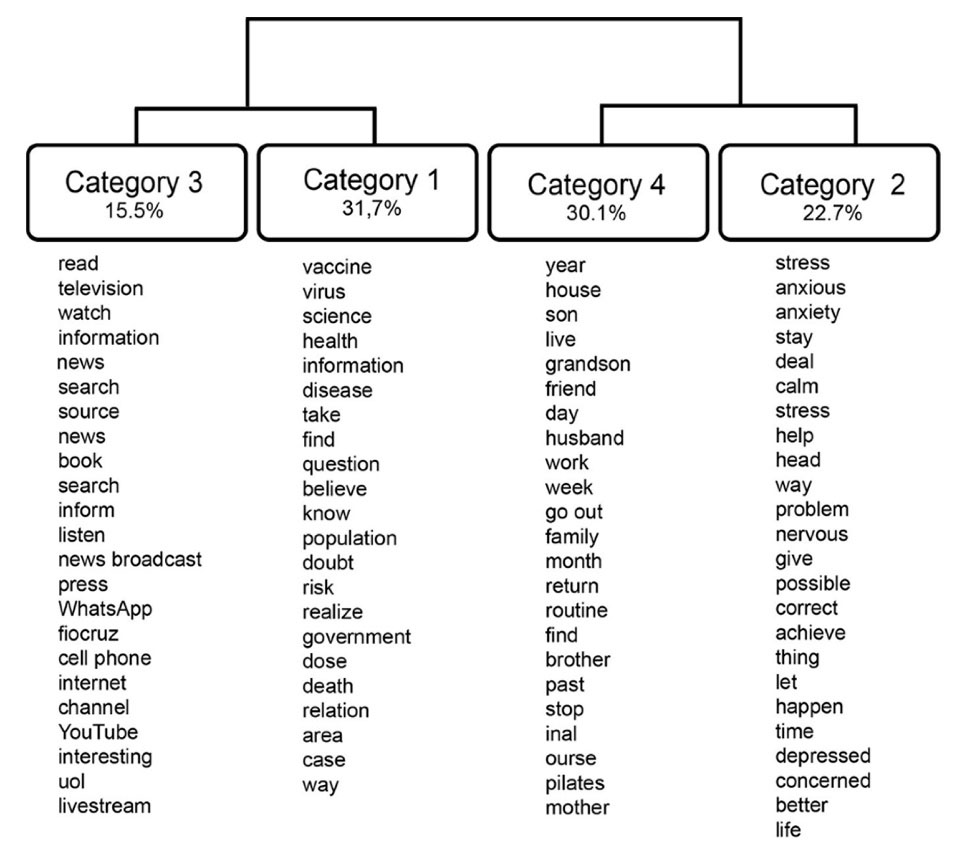
Figure 1.
Dendrogram with the categoriesgenerated from the transcripts of the interviews with the older people. São Paulo/SP, 2022
Source: IRAMUTEQ
.
Dendrogram with the categoriesgenerated from the transcripts of the interviews with the older people. São Paulo/SP, 2022
Source: IRAMUTEQ
I watched all the news every day on the television channels. It was then when I realized I had started to panic. (PI11)
I made comparisons with what was on television, but always in terms of general culture. I watched the news and everything, but I was always looking for a bit more refined information, let’s say. And on WhatsApp I just poof! I quit it, because on WhatsApp, even though I’m not on those groups where people started talking nonsense, I either quit it or the person was excluded from the group itself. (PI32)
Category 1– Contradictions regarding the information disclosed during the pandemic
Concerns were found in their statements regarding how the federal government conducted its actions and their contradictions with state governments in the management of the pandemic. In addition, doubts were raised regarding the varying information provided concerning the COVID-19 vaccine and the vaccination process:
You’ve had one type of vaccine and now you can have a different type. When, in fact, back then they stated that it was forbidden to choose a vaccine type. So this is information that needed to be checked, because I’m going to take the third shot and what happens then? (PI04)
We’ve become hostages to information. So, since it’s new to science, you can only imagine! Anyway, it was all new to science, so now, through experience, new information is being passed on. But we’ve also been held hostage by fake news, which I think is disgraceful, which is a loaded word, but what’s the point of sharing it? (PI05)
Category 4– Reinterpretation in the daily routine of older people during the pandemic
The COVID-19 pandemic has changed the daily lives of older people, who have had to remain isolated in their homes, away from family, friends, and their social network. Meanwhile, they had to readapt to the new circumstances of this new normality, with limitations in terms of maintaining household maintenance and avoiding their own contamination and that of their family members:
My son used to come here, he lives next door, he was far away and he would wear a mask... we’d talk a bit, watch TV, have a snack, eat something to pass the time, and talk about things that were more cheerful than the pandemic. But it was a really boring routine. (PI07)
During the first year, I was absolutely stuck at home, I couldn’t even take the trash out, because there was no vaccine. After the vaccine came out, I started to be more flexible with going out, so I was able to go to the market. I still do, but always with the best mask I have. (PI16)
Category 2– Feelings experienced by older people during the pandemic
It can be noted in the participants’ speeches the presence of negative feelings and mood swings that could have compromised their mental health, evidenced in the content and verbalized in the form of stress, loneliness, sadness, concern, and anxiety caused by the COVID-19 pandemic:
I used to get very upset, I still do.... I think it’s something specific, that is, the sadness I feel. I have moments of sadness and loneliness, of course. (PI39)
But when I go out, I’ll be dealing with people on the plane for 15 hours, I’ll be there, you know, at the exhibition, then I’ll get to my son’s house... What if I spread the virus to my grandchildren, who are twins? So my head got a little overwhelmed, anxiety took over, because I wanted to go and I was scared. (PI37)
In addition, several families have experienced loss, leading to pain and sadness, but the new family configuration has instilled a will to live, by not forgetting their loved ones.
So I was very sad, because I lost family members who live in the Northeast region, in Ceará, Fortaleza. I lost my sister-in-law and my sister’s family, she and her husband and two children also became sick. (PI07)
The figure illustrates, through the words obtained from the participants’ speeches, how older individuals felt when receiving, disseminating, and seeking information related to the COVID-19 pandemic.
Additionally, it highlights the repercussions on their mental health, such as stress, anxiety, and concerns related to their daily experiences with the virus.
Discussion
The study aimed to understand the implications of the infodemic process for daily life, as perceived by the older population in the city of São Paulo during the COVID-19 pandemic. Essential themes were identified in the interviews with the older people, such as the influence of the sociodemographic profile, the governmental management of the pandemic, the distortion of authentic information, emotional instability caused by negative feelings, and the reframing and development of coping strategies during the transition from the pandemic crisis.
The pandemic has transformed the sociodemographic landscape across Brazil, increasing social vulnerability, reducing per capita income, and accelerating disease transmission. 18 These factors have influenced not only the population in general, but also especially the older population.
The sample group described above, composed of female, white individuals with advanced education, high income, and access to technology, represents a social group with characteristics that differ from those of most older people affected by the pandemic, which may have facilitated their coping mechanisms during the crisis.19 According to one study, older people have experienced a reduction in family income, an increase in workload, and have developed feelings of loneliness, sadness, and anxiety, hindering their ability to cope with the pandemic.20
The differences represented in the sociodemographic setting during the COVID-19 health crisis aggravated social inequality and the gap in access to information, which was in contrast to the study population, mainly due to their income and level of education, allowing them access to quality information which led them to isolate themselves comfortably in their homes,21 which provided a reinterpreted and different view of the pandemic for them.
The political scenario in which the pandemic was established was marked by political polarization, where an extreme right-wing government was being supported by negationism, which was being spread through social media, and by the president himself. This, in turn, discredited the pandemic. However, there was another more progressive side, which believed in science as a way to address the pandemic. This duality led to doubts and contradictions in the population’s decision-making process.22
As a result, an informational scenario has emerged in which radical discourses and conspiracy theories have become increasingly widespread, hindering the flow of factual information and increasing the potential for fake news. In addition, with the introduction of the COVID-19 vaccination process, a debate between whether or not to get vaccinated emerged, driven by the misinformative political instrumentalization of science,23 and led to hesitation over the decision to get vaccinated.
This disbelief and support for negationism were not phenomena isolated to Brazil; countries such as India, the United States, China, Spain, and Indonesia also experienced a greater spread of rumors, stigmas, and conspiracy theories between 2019 and 2020. According to data from 2,276 reports, 1,856 statements were false, 204 were accurate, 176 were misleading, and 31 were unverified, highlighting the importance of global and political influence in the information dissemination process and its impact on health.24
Notably, the older population has experienced information overload and an increased susceptibility to the dissemination of false information. The most common news disseminated to this group focused on health threats, mortality, and political decisions, topics that reflected socially constructed roles assigned to older adults, often at the expense of addressing their informational and emotional needs.25
However, even though they are more susceptible to this behavior, the study population were resistant to misinformation, due to their high level of education and a pro-science political stance, which contributed to their criticality towards information.23
A study revealed that 74.6% of women trusted social media less than traditional media, attributing this to higher education levels and intermediate income, which may explain why the studied population was less influenced by the information disseminated through communication channels.26
During the pandemic, major outbreaks and key transmission events led to some information gaps, especially in terms of prevention, strengthening disinformation regarding COVID-19. In addition to this conflict, with the popularization of social media in the Internet era, such as WhatsApp, Facebook, YouTube, and others, the spread of information about the disease in daily life has increased.27
Simultaneously, media coverageof government response and institutional shortcomings raised concerns among older individuals about the adequacy of the healthcare system and the lack of professional preparedness.28
Furthermore, the need for changes in daily life, habits, and priorities has had a negative impact on the mental health of the older population.26 Studies with older people have shown that feelings of fear, anxiety, sadness, and loneliness have been intensified during the pandemic, caused by stressors such as uncertainty regarding the pandemic, the loss of family and friends, and the possibility of becoming ill themselves.29,30
It should also be noted that the female community has suffered significant implications as a result of isolation, such as an increase in the number of tasks performed, demonstrating the conflict between domestic, work, and parental activities. While physical, emotional, and work overloads have been shown to be concerning elements in daily life, where self-care has been neglected, highlighting how this situation intensified the prejudice surrounding the social role of women as multitaskers, in the division between caring for their families and working, as well as in many other aspects that rendered them vulnerable during the pandemic.31,32
The social isolation dichotomy and the challenges faced during the pandemic, at times due to fear and anxiety, at other times due to coping and normality, have changed the routine of the older population, transforming restrictions into opportunities for social and collective readjustment. Thus, what were once challenges have become positive actions of solidarity and empathy, highlighting the sense of collectivity as a way of dealing with the consequences of COVID-19 in the lives of families33 while the quality and quantity of information available in the media plays a paramount role in how people respond and behave.34
The challenging panorama with changes in daily life and psychological consequences, while being a moment of resignification and development of coping strategies during the transition from the pandemic crisis, was also essential for daily readaptation through physical exercises, manual activities, online classes, remote work, and the comfort of family and spirituality, in order to balance the various experiences encountered during this period.35
During the course of the study, a limitation was found regarding the fact that the study sample consisted of older people with a high level of education, internet access, use of technology, and who did not experience any changes in monthly income during the pandemic, therefore the data cannot be inferred for the entire older population living in São Paulo.
Moreover, it is necessary to conduct future in-depth research on similar crises to thoroughly understand how the infodemic may interfere with the behavior, thoughts, and experiences and in coping strategies of the older in regions with varying economic conditions in the city of São Paulo, in order to provide reliable support for their mental health care.
Conclusion
This study aimed to investigate how the older population in São Paulo perceived the infodemic process during the COVID-19 pandemic and how the daily lives of this population have changed. The findings showed that, even in the face of a pandemic crisis scenario and information overload, it was possible to readapt, depending on their socioeconomic, cultural, and spiritual conditions, although it may have caused emotional consequences such as stress and anxiety. Therefore, this study, from the perspective of the older population, provided a broader understanding of their mental and social health needs, allowing healthcare professionals to better support the multidimensional care of older individuals and to design future strategies for addressing potential pandemics followed by an infodemic.
Acknowledgments
There are no acknowledgments to declare.
Competing Interests
The authors declare no conflict of interest.
Data Availability
The datasets are available from the corresponding author upon reasonable request.
Ethical Approval
This study was reviewed and approved by the Research Ethics Committee of the Nursing School of the University of São Paulo (CAAE no. 31932620.1.1001.5147; Opinion no. 4.134.050).
Prior to each interview, participants were verbally informed about the study and gave verbal consent. Subsequently, the Informed Consent Form was emailed to them.
References
- Pan American Health Organization. Fact sheet on COVID-19. https://www.paho.org/pt/topicos/coronavirus/doenca-causada-pelo-novo-coronavirus-covid-19. Published/updated date not given. Accessed at: September 19, 2024.
- Ministry of Health of the Federal Government of Brazil. Epidemiological Bulletin No. 40 - COE Coronavirus Bulletin. Accessed May 18, 2022. https://www.gov.br/saude/pt-br/centrais-de-conteudo/publicacoes/boletins/epidemiologicos/covid-19/2021/boletim_epidemiologico_covid_58.pdf/view.
- Ministry of Health of the Federal Government of Brazil. Epidemiological Bulletin No. 58 - COE Coronavirus Bulletin. Accessed May 18, 2022. Available from:https://www.gov.br/saude/pt-br/centrais-de-conteudo/publicacoes/boletins/epidemiologicos/covid-19/2021/boletim_epidemiologico_covid_58.pdf/view.
- França EB, Ishitani LH, Teixeira RA, Abreu DMXD, Corrêa PRL, Marinho F. Deaths due to COVID-19 in Brazil: how many are there and which are being identified? Braz J Epidemiol 2020;23:e200053. how many are there and which are being identified? Braz J Epidemiol 2020; 23:how many are there and which are being identified? Braz J Epidemiol 2020;23. doi: 10.1590/1980-549720200053 [Crossref] [ Google Scholar]
- Fontes WHA, Gonçalves Júnior J, de Vasconcelos CAC, da Silva CGL, Gadelha MSV. Impacts of the SARS-CoV-2 Pandemic on the Mental Health of the Elderly. Front Psychiatry 2020; 11:841. doi: 10.3389/fpsyt.2020.00841 [Crossref] [ Google Scholar]
- Pan American Health Organization. Understanding the Infodemic and Misinformation in the fight against COVID-19. 2020. https://iris.paho.org/handle/10665.2/52052.
- Arpasi-Quispe O, Fernandes-Molocho L, Mocarro-Aguilar M, Díaz-Orihuela M, Silva Fhon J. Stress in the elderly in the context of the covid-19 pandemic and its associated factors. Cogitare Enfermagem 2023;28. 10.1590/ce.v28i0.87475
- Picaza Gorrochategi M, Eiguren Munitis A, Dosil Santamaria M, Ozamiz Etxebarria N. Stress, Anxiety, and Depression in People Aged Over 60 in the COVID-19 Outbreak in a Sample Collected in Northern Spain. Am J Geriatr Psychiatry 2020; 28(9):993-8. doi: 10.1016/j.jagp.2020.05.022 [Crossref] [ Google Scholar]
- World Health Organization. Infodemic. Available from: https://www.who.int/health-topics/infodemic#tab=tab_1.
- Delgado CE, Silva EA, Castro EAB, Carbogim FDC, Püschel VAA, Cavalcante RB. COVID-19 infodemic and adult and elderly mental health: a scoping review. Rev Esc Enferm USP 2021; 55:e20210170. doi: 10.1590/1980-220x-reeusp-2021-0170 [Crossref] [ Google Scholar]
- Cavalcante RB, Carbogim F da C, Bulgarelli AF, dos Santos CM, Ribeiro AQ, Pinto IC, et al. Repercussions of infodemia associated with COVID-19 on the mental health of the elderly in Brazil. Rev. cuba. inf. cienc. salud [Internet]. 2022 Apr. 16 [cited 2026 Mar. 29];33. Available from: https://acimed.sld.cu/index.php/acimed/article/view/1871.
- Tong A, Sainsbury P, Craig J. Consolidated criteria for reporting qualitative research (COREQ): a 32-item checklist for interviews and focus groups. Int J Qual Health Care 2007; 19(6):349-57. doi: 10.1093/intqhc/mzm042 [Crossref] [ Google Scholar]
- Fhon JRS, Püschel VAA, Cavalcante RB, Cruz FV, Gonçalves LN, Li W. Infodemic of covid-19 and repercussions on the mental health of the elderly from São Paulo. Rev Esc Enferm USP 2022; 56:e20210421. doi: 10.1590/1980-220X-REEUSP-2021-0421en [Crossref] [ Google Scholar]
- Saunders B, Sim J, Kingstone T, Baker S, Waterfield J, Bartlam B. Saturation in qualitative research: exploring its conceptualization and operationalization. Qual Quant 2018; 52(4):1893-907. doi: 10.1007/s11135-017-0574-8 [Crossref] [ Google Scholar]
- Software IRaMuTeQ. Version 0.8 alpha 7. Laboratory of Social Psychology of Communication and Cognition. Accessed February 9, 2024. Available from:https://laccos.ufsc.br/software-iramuteq/.
- Bardin L. Content analysis. 70 ed: French: Presses Universitaires de France; 2011.
- Miles MB, Huberman AM, Saldaña. Qualitative Data Analysis: A Methods Sourcebook. 3 ed: London: Sage; 2014.
- Norenã AL, Alcaraz-Moreno N, Rojas JG, Rebolledo-Malpica D. Applicability of rigor and ethical criteria in qualitative research. Aquichán 2012; 12(3):263-74. [ Google Scholar]
-
. Research, Society and Development 2021;10(6):e34110615507. Research, Society and Development 2021; 10(6):e34110615507. doi: 10.33448/rsd-v10i6.15507 [Crossref] [ Google Scholar]
- Dhama K, Patel SK, Kumar R, Rana J, Yatoo MI, Kumar A. Geriatric Population During the COVID-19 Pandemic: Problems, Considerations, Exigencies, and Beyond. Front Public Health 2020; 8:574198. doi: 10.3389/fpubh.2020.574198 [Crossref] [ Google Scholar]
- Vahia IV, Jeste DV, Reynolds CF, 3rd 3rd. Older Adults and the Mental Health Effects of COVID-19. Jama 2020; 324(22):2253-4. doi: 10.1001/jama.2020.21753 [Crossref] [ Google Scholar]
- Kalache A, Silva A, Giacomin K, Lima K, Ramos L, Louvison M, et al. Aging and inequalities: social protection policies for older adults resulting from the Covid-19 pandemic in Brazil. Revista Brasileira de Geriatria e Gerontologia 2020;23. 10.1590/1981-22562020023.200122
- Meghana GVR, Chavali DP. Examining the Dynamics of COVID-19 Misinformation: Social Media Trends, Vaccine Discourse, and Public Sentiment. Cureus 2023; 15(11):e48239. doi: 10.7759/cureus.48239 [Crossref] [ Google Scholar]
- Islam MS, Sarkar T, Khan SH, Mostofa Kamal AH, Hasan SMM, Kabir A. COVID-19-Related Infodemic and Its Impact on Public Health: A Global Social Media Analysis. Am J Trop Med Hyg 2020; 103(4):1621-9. doi: 10.4269/ajtmh.20-0812 [Crossref] [ Google Scholar]
- Fhon JRS, Silva LM, Leitón-Espinoza ZE, Matiello FB, Araujo JS, Rodrigues RAP. Hospital care for elderly COVID-19 patients. Rev Lat Am Enfermagem 2020; 28:e3396. doi: 10.1590/1518-8345.4649.3396 [Crossref] [ Google Scholar]
- Kitamura ES, Cavalcante RB, Castro EABd, Leite ICG. Covid-19 infodemic in elderly people with access to digital media: factors associated with psychopathological changes. Rev Bras Geriatr Gerontol 2022; 25(6):e220016. doi: 10.1590/1981-22562022025.220016pt [Crossref] [ Google Scholar]
- Sundelson AE, Jamison AM, Huhn N, Pasquino SL, Sell TK. Fighting the infodemic: the 4 i Framework for Advancing Communication and Trust. BMC Public Health 2023; 23(1):1662. doi: 10.1186/s12889-023-16612-9 [Crossref] [ Google Scholar]
- Pakalniškienė V, Kairys A, Jurkuvėnas V, Mikuličiūtė V, Ivleva V. Could Belief in Fake News Predict Vaccination Behavior in the Elderly? Int J Environ Res Public Health 2022;19(22):14901. Could Belief in Fake News Predict Vaccination Behavior in the Elderly? Int J Environ Res Public Health 2022; 19(22):14901. doi: 10.3390/ijerph192214901 [Crossref] [ Google Scholar]
- Pant S, Subedi M. Impact of COVID-19 on the elderly. Journal of Patan Academy of Health Sciences 2020; 7:32-8. doi: 10.3126/jpahs.v7i2.31104 [Crossref] [ Google Scholar]
- Ruzafa-Martinez M, García-González J, Morales-Asencio JM, Leal-Costa C, Hernández-Méndez S, Hernández-López MJ. Ruzafa-Martinez M, García-González J, Morales-Asencio JM, Leal-Costa C, Hernández-Méndez S, Hernández-López MJ, et alConsequences of the Covid-19 pandemic on complex multimorbid elderly: Follow-up of a community-based cohortSAMAC3 Study. J Nurs Scholarsh 2023; 55(4):792-804. doi: 10.1111/jnu.12860 [Crossref] [ Google Scholar]
- Dziedzic B, Idzik A, Kobos E, Sienkiewicz Z, Kryczka T, Fidecki W. Loneliness and mental health among the elderly in Poland during the COVID-19 pandemic. BMC Public Health 2021; 21(1):1976. doi: 10.1186/s12889-021-12029-4 [Crossref] [ Google Scholar]
- Webb LM, Chen CY. The COVID-19 pandemic’s impact on older adults’ mental health: Contributing factors, coping strategies, and opportunities for improvement. Int J Geriatr Psychiatry 2022;37(1). 10.1002/gps.5647
- Kolakowsky-Hayner SA, Goldin Y, Kingsley K, Alzueta E, Arango-Lasprilla JC, Perrin PB, et al. Psychosocial Impacts of the COVID-19 Quarantine: A Study of Gender Differences in 59 Countries. Medicina (Kaunas) 2021;57(8). 10.3390/medicina57080789
- Bhat N, Paul FA, Gul A, Ganie ZA. Loneliness and social isolation: exploring the experiences of older women during the pandemic in terms of social connection, feeling of loneliness, and the impact on mental health and wellbeing. Front Glob Womens Health 2024; 5:1410058. doi: 10.3389/fgwh.2024.1410058 [Crossref] [ Google Scholar]
- Maksimovic N, Gazibara T, Dotlic J, Milic M, Jeremic Stojkovic V, Cvjetkovic S. “It Bothered Me”: The Mental Burden of COVID-19 Media Reports on Community-Dwelling Elderly People. Medicina (Kaunas) 2023; 59(11):2011. doi: 10.3390/medicina59112011 [Crossref] [ Google Scholar]