Journal of caring sciences. 14(2):93-101.
doi: 10.34172/jcs.025.35014
Review Article
Exploring the Emergent Concept of Patient Advocacy in Acute and Perioperative Settings: A Scoping Review
Sara Morais Pires Conceptualization, Data curation, Formal analysis, Investigation, Methodology, Resources, Project administration, Validation, Visualization, Writing – original draft, Writing – review & editing, 1, 2, * 
Ana Ramos Formal analysis, Investigation, Methodology, Validation, Visualization, Writing – review & editing, 2, 3
Idalina Gomes Conceptualization, Data curation, Formal analysis, Project administration, Supervision, Validation, Visualization, Writing – review & editing, 2
Author information:
1Nursing School of Lisbon, the University of Lisbon, Lisbon, Portugal
2Department of Medical-Surgical Nursing, Nursing School of Lisbon, Nursing Research, Innovation and Development Centre of Lisbon (CIDNUR), Lisbon, Portugal
3Comprehensive Health Research Center (CHRC), Évora, Portugal
Abstract
Introduction:
Staff shortages following the pandemic and the growing complexity of healthcare require continuous reflection on the part of professionals to improve patient protection efforts in high-pressure environments. This makes it essential to better understand and reinforce the role of patient advocacy in clinical practice. This study aims to map the concept of patient advocacy in nursing, identifying its key attributes, antecedents, and consequences in acute and perioperative settings, contributing to its update and integration into the current healthcare paradigm.
Methods:
A scoping review, based on Arksey and O’Malley’s framework and PRISMA-ScR guidelines, analyzed studies from 2019 to 2024, across CINAHL, PubMed, Scopus, Web of Science, and Google Scholar databases. It focused on nursing-related patient advocacy in acute and perioperative settings, excluding non-nursing roles, self-advocacy, and non-research articles. Two independent reviewers independently selected 14 studies using Rayyan®.
Results:
Key attributes of patient advocacy include safeguarding, effective communication, empowerment, and ethical decision-making support. Facilitating antecedents were professional motivation, training, nurse autonomy, and spiritual care, while hindering factors included ineffective communication, religious/cultural conflicts, and gaps in patients’ health literacy. The consequences were mostly positive for patients, such as empowerment and shared decisions, and mixed for nurses, ranging from moral distress and frustration to gratitude and professional satisfaction.
Conclusion:
This study synthesized the evolving conceptualizations of patient advocacy, addressing post-pandemic challenges and reinforcing the importance of communication, ethical support, and training. It revealed emerging facilitators and previously overlooked barriers, highlighting the need for stronger policies and organizational structures to empower nurses and safeguard patients.
Keywords: Acute care, Patient advocacy, Patient rights, Nursing care, Perioperative care, Review
Copyright and License Information
© 2025 The Author(s).
This work is published by Journal of Caring Sciences as an open access article distributed under the terms of the Creative Commons Attribution Non-Commercial License (
http://creativecommons.org/licenses/by-nc/4.0/). Non-commercial uses of the work are permitted, provided the original work is properly cited.
Funding Statement
No financial or grant support was received for this concept clarification publication.
Introduction
Advocacy originates from the Latin term advocatus, meaning “one who is called to aid or defend another”.1 Although other health professionals defend their patients, nursing as a profession has incorporated the concept of advocacy since 1973, introduced by the International Council of Nurses (ICN) in the profession’s Code of Ethics, considering that nursing promotes respect for human rights, including the right to life and to be treated with respect.2 In the Declaration of Alma-Ata, drawn up by the World Health Organisation (WHO) in 1978, people were recognised as having the capacity and possibility to be agents and partners in their therapeutic decisions. Until then, patients were seen as passive agents without active participation in decision, and decisions about their health were the sole and exclusive responsibility of health professionals.3However, it is important to highlight that Nightingale presented characteristics of patient advocacy in her work, considering nursing professionals as protectors of life, which included patient advocacy, the promotion of human rights, and the protection of vulnerable groups.4
Evidence shows that advocating for the patient is central to nursing practice. It encompasses acting in favor of the person’s best interests, promoting their well-being,5 providing adequate information,6 protecting their rights,6 and defending them from inappropriate practices exercised by other health professionals, and guaranteeing the quality of care.7 However, nurses face some challenges when exercising this advocacy, including individual and institutional barriers, and actions of this nature vary according to culture, clinical situations and professional practice environments.8
Various studies have attempted to analyse and clarify this concept over time, due to the varied interpretations that have developed with the consolidation of patients’ rights. Bu and Jezewski based their work on Walker and Avant’s conceptual analysis method, combined with an extensive literature review, from which they developed a mid-range theory. This theory attributed three adjacent characteristics to patient advocacy, namely: protecting the patient’s autonomy; acting in the patient’s defense and promoting social justice in healthcare.9 More recently, Abbasinia et al,10 starting from the premise that this concept was not yet clearly conceptualised, developed a comprehensive conceptual analysis of the concept from 1850 to 2016. The author’s analysis was categorical in stating that the concept of patient advocacy is defined by the following attributes: safeguarding; mediating and being the voice of patients; defending social justice in healthcare provision.10
In acute and perioperative settings, patient advocacy is particularly critical due to the heightened vulnerability of patients undergoing surgical or intensive treatments. The evidence already reveals the need for patient advocacy to be developed in the perioperative period, because there is a need for nurses to communicate with and protect people who are unable to do so themselves. It centres on people being informed about the surgery they are about to undergo, not just by signing the informed consent form, but that they have understood the interventions involved, in so far as the the lack of information may be perceived as a violation of patient autonomy; as well as enhancing communication among healthcare team members, contributing to increasing the safety of the person being cared for.8,11,12Research indicates that advocacy interventions in perioperative care often focus on direct patient education, utilizing consultation-based approaches that incorporate written, digital, or multimedia materials. These educational efforts aim to empower patients with knowledge about their procedures and recovery processes, thereby enhancing their autonomy and engagement in care decisions.13,14
In the context of patient advocacy in ICUs, four key themes emerge in nursing discourse: the responsibility to uphold patient autonomy in treatment decisions, the duty to protect patients from potential harm caused by physicians, the role of acting as an intermediary between the patient and the physician, and the obligation to support the overall well-being of the patient.14
Recognizing these contextual differences allows nurses to tailor their advocacy strategies, ensuring that patients receive the appropriate level of support based on their specific healthcare setting.9 The novelty of this study lies in its updated conceptual analysis of patient advocacy in the post-pandemic context, where rapid clinical changes demand renewed ethical frameworks. Findings from a previous study,7 which revealed significant associations between demographic factors and nurses’ advocacy behavior, ethical decision-making, and whistleblowing intentions, underscore the urgent need to deepen and clarify the concept. This work also addresses that need, exploring how advocacy is understood and practiced in acute care settings today, and offering a foundation for more targeted, ethical, and effective nursing interventions. Analysing the concept of patient advocacy can, therefore, provide valuable insights in this context. Given the broad and evolving interpretations of advocacy, a scoping review is warranted to map its conceptual boundaries and applications in acute care. This study aims to map the concept of patient advocacy in nursing, identifying its key attributes, antecedents, and consequences in acute and perioperative settings, contributing to its update and integration into the current healthcare paradigm.
Materials and Methods
This scoping review emerged from the need to analyze the available evidence on the definition of patient advocacy. Scoping reviews can map out the main concepts underlying the research area and clarify a topic’s working definitions and/or conceptual boundaries.15 We followed the five scoping review steps outlined in the methodological framework of Arksey and O’Malley15 and adhered to the Preferred Reporting Items for Systematic Reviews and Meta-Analyses extension for Scoping Reviews (PRISMA-ScR) Checklist.16-18The protocol was registered on Open Science Framework (https://doi.org/10.17605/OSF.IO/UQVPH).
Firstly, as this is a conceptual review, the research questions were constructed by defining the concept, as they are based on some of the central premises of the conceptual analysis model proposed by Walker and Avant.19 We used the Population-Concept-Context (PCC) model, according to the JBI, as the study design, where “Population (P)” refers to “nurses”, the “Concept (C)” refers to “Patient Advocacy” and the “Context (C)” designates “nursing care”. The research questions are as follows:
Research question 1: How is the concept of patient advocacy, defined in nursing practice in acute and perioperative settings??
Research question 2: What are defining attributes of the concept?
Research question 3:What are the antecedents and the consequences of the concept?
Step 2: Identifying Relevant Studies
Search Strategy
Two researchers with expertise in conducting literature reviews were responsible for developing and executing the search strategy. Boolean operators were used to combine search terms, which included: “nurses”, “patient advocacy” and “nursing care” which were expanded through their similarities. The following databases were systematically searched: CINAHL, PubMed, Scopus, Web of Science, and Google Scholar.
Data Inclusion and Exclusion Criteria
We included studies published in English, Spanishand Portuguese. To capture recent developments in practice, we included studies published in the last five years, from 2019 to 2024. Given that the last comprehensive review of the concept of patient advocacy was published in 2020,10 with studies before that date, we consider it pertinent to cover these last few years, also as a way of surfacing intra- and post-pandemic results. Thus, studies whose population consisted of nurses were included, focusing on patient advocacy in acute and perioperative settings. Articles were excluded if they did not align with the concept of patient advocacy or if they focused exclusively on advocacy performed by non-nursing professionals, students, or self-advocacy. Opinion pieces, case reports, and editorials were also excluded. However, studies involving interprofessional advocacy (e.g., nurse-physician collaborations) were included, provided the nurse’s role in the advocacy process was clearly identifiable. This review includes primary studies with a qualitative, quantitative, or mixed design, as well as secondary studies. A search was conducted using the databases CINAHL, PubMed, Scopus, Web of Science and Google Scholar for articles published in peer-reviewed journals using the following search terms “Nurses” AND “Patient Advocacy” OR “Patient Rights” OR “Patient Navigation” AND “Nursing Care” OR “Nursing Practice” OR “Nursing Role” AND “Acute Care” OR “Perioperative Care”.
Step 3: Study Selection
The search result identified a total of 640 articles. We excluded 210 duplicates and we screened the titles and abstracts of 430 articles. From the grey literature, 45 articles emerged, totalizing 475 articles for screening. Of those 475 articles, 405 did not meet the criteria. Hence, only the full texts of 70 articles were reviewed. Of these 70 articles, we excluded 26 with the ineligible study design, 9 without the eligible language, 6 not target nurses, 13 were not related to patient advocacy and 2 were not available (Figure 1).
The selection of studies was carried out by two independent reviewers and took place in two phases: in the first phase, the titles and abstracts were read, and in the second phase, the texts were read in full to determine whether the inclusion and exclusion criteria were met. Duplicates were removed using the Rayyan® tool.
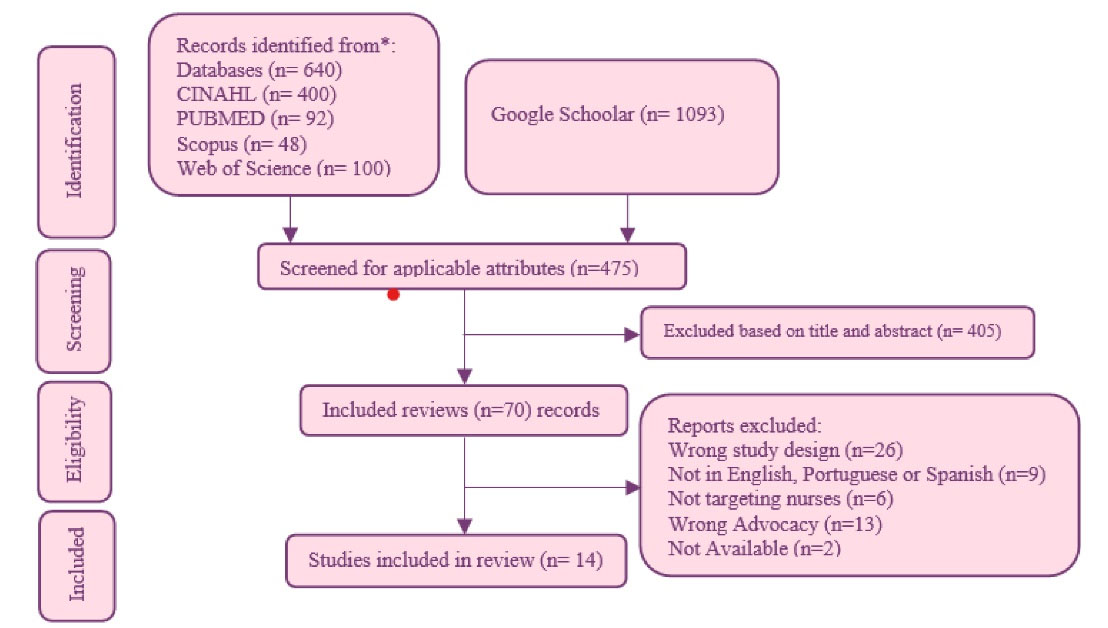
Figure 1.
PRISMA diagram for conceptual analysis of patient advocacy in nursing. Cumulative Index to Nursing and Allied Health Literature (CINAHL), PubMed, Scopus, Web of Science and Google Scholar
.
PRISMA diagram for conceptual analysis of patient advocacy in nursing. Cumulative Index to Nursing and Allied Health Literature (CINAHL), PubMed, Scopus, Web of Science and Google Scholar
Step 4: Charting the Data
The data were extracted into a table containing the following elements: author/year of publication/country; type of study; population; defining attributes; antecedents and consequences of patient advocacy. This thematic categorization followed some of the crucial steps of Walker and Avant’s19concept analysis framework, which emphasises the identification of defining attributes, antecedents and consequences as essential components in clarifying a concept.
Two reviewers independently coded the extracted data, identifying recurring concepts across studies. Discrepancies were resolved by consensus, with input from a third reviewer when necessary. Themes were validated if supported by findings from multiple studies. The final themes were synthesized into a conceptual map to visually represent the interrelationships and contextualize patient advocacy within acute and perioperative nursing care.
Step 5: Collating, Summarizing, and Reporting Results
The summarized results and the distribution of articles across key themes are presented in a table and a conceptual map within the results section. Conceptual maps serve as a valuable graphic representation, facilitating the organization and visualization of knowledge.20 They provide an effective means for mapping and clarifying complex concepts such as patient advocacy.
Results
General Characteristics
Regarding the years of publication, of most studies were published in 2019 (n = 5), 2020 (n = 3), 2021 (n = 1), 2022 (n = 1), 2023 (n = 3) and 2024 (n = 1). The studies included in the document were conducted across a total of 9 different countries. Specifically, in Ghana (n = 2), Spain (n = 1), Iran (n = 2), Brazil (n = 4), Turkey (n = 2), Saudi Arabia (n = 1), United States (n = 1) and Australia (n = 1). The studies used a variety of research methodologies, with most being qualitative designs (n = 8). Other methods included quantitative studies (n = 4) and secondary research, such as integrative reviews or systematic reviews (n = 2). All studies focused on nursing professionals as the primary sample, exploring various aspects of patient advocacy across different healthcare settings. Regarding the contexts of the studies, they include medical-surgical inpatient units (n = 4), intensive care units (n = 4), emergency departments (n = 1), and less frequently settings focused on cardiopulmonary resuscitation (n = 1). Additionally, (n = 4) of the studies were conducted with nurses from various units, such as surgical, medical, children’s wards, maternity and ICU’s. All studies had nursing professionals as a sample (Table 1).
Thematic Characteristics
Analysis of 14 studies (Table 1) revealed five key attributes of patient advocacy, along with five facilitators and five barriers. Additionally, the review identified four consequences of advocacy for nurses and four for patients, which are illustrated in a conceptual map (Figure 2).
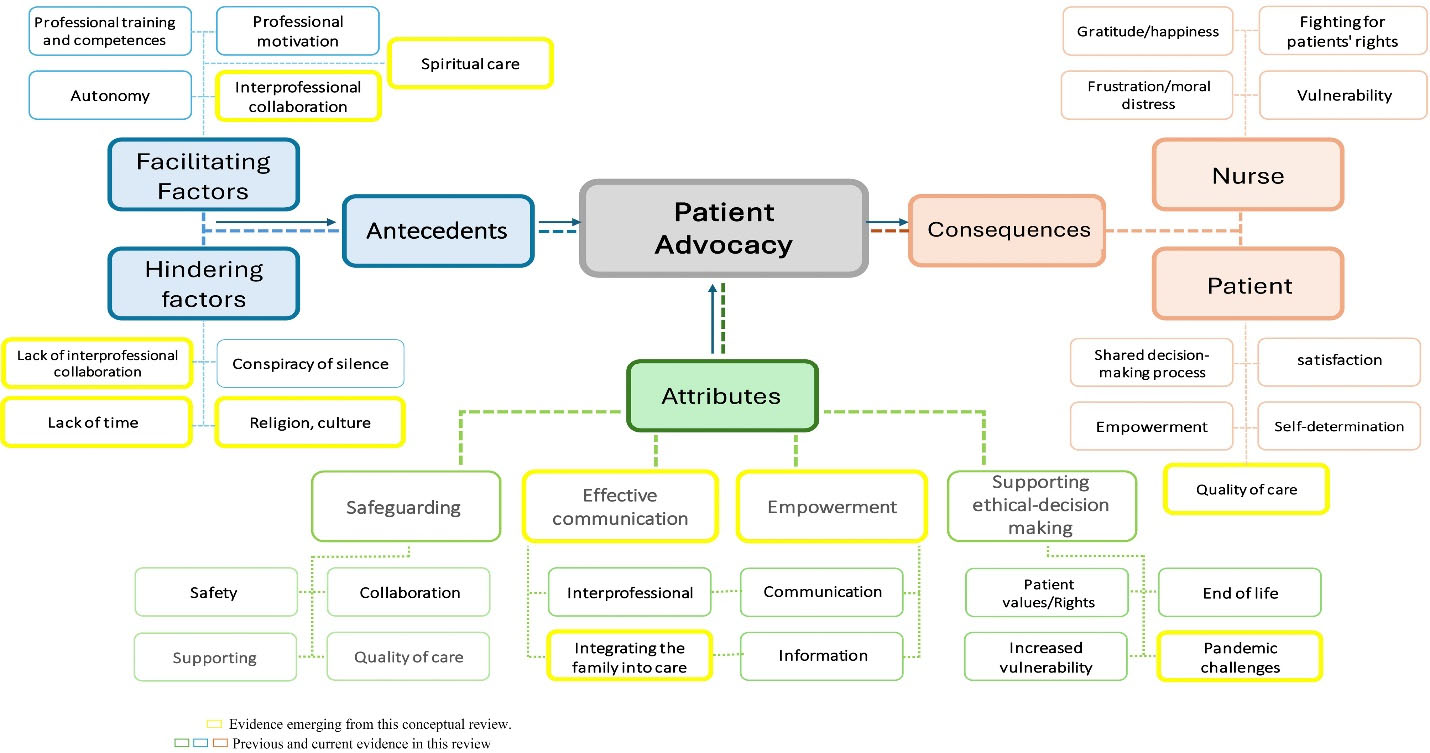
Figure 2.
Conceptual map with the attributes, antecedents, and consequences of patient advocacy
.
Conceptual map with the attributes, antecedents, and consequences of patient advocacy
Attributes
The key attributes of advocacy that emerged include: safeguarding,10,21,24,27,29 effective communication,10,22,25,30,33 empowerment,10,24and supporting ethical decision-making.21,24-25,29-32
Concerning safeguarding, priority is given to safety,21,24,29 supporting,22 collaboration28 and the promotion of quality care.21,32 Effective communication is vital for ensuring that patients understand their treatment options and that their preferences are communicated to healthcare providers, with the nurse acting as the voice of the patient,21 and integrating the family into care.31 Access to information24,27,33 and maintaining communication25,30,33 with healthcare professionals were identified as essential factors in promoting patient empowerment. Support for ethical decision-making is also important when it includes patients’ rights,22,25,29-31 and values,25 situations of increased vulnerability22,31 and the end of life.22
Antecedents
Through the literature review, facilitating and hindering factors emerged as antecedents for developing patient advocacy. Facilitating factors include professional motivation,10,23 which drives nurses to advocate for their patients; interprofessional collaboration21; spiritual care32; professional training,23,27 higher education; ongoing training were reported to improve nurses’ confidence and advocacy skills, competencies, and professional autonomy.29
On the other hand, several barriers factors can obstruct patient advocacy. One major barrier identified was the conspiracy of silence,22 often surrounds sensitive issues such as end-of-life care, preventing transparent discussions and shared decision-making. Similarly, some studies have identified a lack of interprofessional collaboration23 as a major barrier, limiting the teamwork necessary for effective advocacy. Religion, culture, and illiteracy10,24were also cited as barriers that may conflict with medical recommendations. Additionally, ineffective communication,25,33 makes it difficult for nurses to advocate effectively. Finally, lack of time,25 due to heavy workloads and time constraints was another limiting factor in nurses’ ability to engage in advocacy.
Consequences
The consequences of patient advocacy are significant for both patients and nurses. For patients, advocacy leads to empowerment,21,22,27,30 self-determination,21 and shared decision-making,21 allowing them to take control of their care. Some studies emphasize how advocacy strengthens the nurse-patient relationship.21,33
While advocacy often led to professional satisfaction10,27,29 and gratification,29failures due to systemic barriers resulted in frustration 21and moral distress.10,27,33
Discussion
The concept of patient advocacy is fundamental to nursing, and through the examination of the latest studies, the scope of advocacy is evolving. The current analysis builds on the foundational definitions provided by earlier works but introduces new dimensions that broaden the understanding of what patient advocacy entails. The studies reveal fundamental insights into the attributes, antecedents, and consequences of patient advocacy.
Attributes of Patient Advocacy
Concerning attributes, safeguarding, effective communication, empowerment, and support for ethical decision-making are particularly prominent. It is irrefutable that one of the central attributes of patient advocacy is safeguarding patients, particularly in clinical settings, where patients are vulnerable to medical errors or inadequate care.21 Specifically, in ICU settings, particularly during the COVID-19 pandemic, nurses were pivotal in safeguarding patient rights by preventing harm, ensuring safety, and providing necessary information to patients and their families about treatment options, promoting the presence of the family in the context.24,31
In recent revisions of the concept, patient advocacy is a process that involves facilitating communication between patients, families, and healthcare providers, ensuring that patients understand their medical conditions and the available treatment options.10 Effective communication is crucial for ensuring patient safety and quality care, allowing nurses to act as the patient’s voice,10,21 for promoting patient values and autonomy, particularly in intensive care settings.24 Additionally, maintaining communication between nurses and patients is the key to defending patient rights and ensuring their participation in decision-making about their care.30
During the COVID-19 pandemic, patient advocacy gained heightened relevance, particularly in ICUs where patients were isolated from their families. Nurses played a crucial role in reducing harm and promoting informed decision-making, despite challenging circumstances. Studies highlight how nurses adapted by integrating family presence remotely, ensuring that patients’ social and emotional needs remained part of the care process.24,31 The results of two studies showed that the pandemic required nurses to adapt their advocacy practices, particularly in ICUs where patients were isolated from their families. New strategies emerged to ensure patient safety and rights, despite the physical absence of family members during treatment.24,31
However, beyond the pandemic context, patient advocacy remains central in various acute and perioperative scenarios. Empowerment21,22,27,30 has become a central attribute in recent discussions.Advocacy includes empowering patients to take control of their healthcare decisions. This shift from a purely protective role to an empowering one marks a significant evolution in the way advocacy is understood. These findings suggest that patient advocacy is moving away from being the voice of the patient,10,21 towards empowering them with information,10,21,24,30 so that they can decide for themselves, as in the case of signing informed consent. Even in crisis and situations emergencies, it often includes educating patients and ensuring that they can make informed choices about their care.23
Supporting ethical decision-making is a key aspect of patient advocacy, requiring nurses to respect patient values, especially in complex situations like end-of-life care or resuscitation, where ethical, legal, and cultural factors must be carefully balanced. 22
Similarly, another study describes how advanced practice registered nurses (APRNs) are required to make ethical decisions daily, often without formal education on patient advocacy, relying instead on their personal and professional judgment to safeguard patient interests.27 In these scenarios, nurses act as ethical agents, ensuring that care aligns with the moral and ethical frameworks that prioritize patient dignity and autonomy.22,27
Table 1.
Table of articles selected for concept clarification
|
Author, year, country
|
Aim
|
Study type and design
|
Population
|
Defining Attributes
|
Antecedents
|
Consequences
|
A1. Nsiah et al21
(2019), Ghana |
To explore and describe patient advocacy as perceived by registered nurses in clinical settings |
Qualitative study using semi-structured interviews and thematic analysis |
25 registered nurses from various wards (surgical, medical, children’s wards, maternity, ICU’s) |
Patient safety, defending patients’ rights, ensuring quality care, and being the patients’ voice. An empowering practice environment |
Interpersonal relationships, self-determination, patient education, and availability of nurses |
Empowering practice environment, enhances patient involvement in decision-making, and promotes patient-centered care |
A2. Tíscar-González et al22
(2020), Spain |
To explore the nurse's role in patient advocacy during cardiopulmonary resuscitation (CPR) |
Exploratory critical qualitative study using thematic analysis |
Four discussion groups including patients, relatives, nurses, and physicians |
Supporting patients during end-of-life situations in CPR contexts. Empowerment of nursing ethical practice |
Challenges include legal uncertainty, concerns about maintaining silence, and socio-cultural contexts that influence denial of death and paternalism |
Nurses act as patient advocates but often as intermediaries in CPR, balancing ethical dilemmas and the need for discretion |
| A3. Adjei et al23 (2023), Ghana |
To explore emergency nurses’ experiences of patient advocacy |
Descriptive qualitative study using interviews |
15 emergency department nurses with 3-12 years of experience, from various professional levels |
Educating patients to make informed choices, speaking or acting on behalf of patients, and addressing direct medical care issues |
Motivated by personal upbringing, professional training, and religious teachings. Hindered by negative interprofessional experiences, patient and relative attitudes |
Advocacy in emergency department settings is complex and difficult |
A4. Aghaie et al24
(2021), Iran |
To explore Iranian ICU nurses’ perceptions of advocacy for COVID-19 patients |
Descriptive qualitative study using interviews |
A total of 18 clinical nurses from the intensive care units of three hospitals. |
Promoting patient safety, respecting patients’ values, and providing necessary information to patients and their families |
Supporting patients by informing physicians about treatment complications and preventing medical errors also involves providing comfort at the end of life |
Advocacy during COVID-19 was critical for reducing harm and ensuring patients were informed and involved in treatment decisions |
A5. Vargas et al25
(2019), South and Southeast regions of Brazil |
To explore the actions and factors associated with patient advocacy by ICU nurses using the Protective Nursing Advocacy Scale |
Quantitative, descriptive, exploratory, cross-sectional study |
451 nurses working in ICUs |
Nurse communication to educate patients and families about their rights and duties, and see patient care as synonymous with patient advocacy |
Barriers include high physical and mental demands, particularly for nurses holding multiple jobs, leading to compromised quality of life and work |
Patient advocacy remains a subject requiring further study |
A6. Alanezi26
(2020), Saudi Arabia |
To determine nurses’ attitudes toward patient advocacy in a single tertiary care hospital |
Descriptive/analytical cross-sectional studies. |
Nurses working in various departments, including emergency, ICU, medical and surgical wards, and specialized units |
Associated with positive attitudes, higher qualification levels leading to better behavioral and cognitive advocacy, and an ethical obligation to act as patient advocates. |
Influenced by educational programs and organizational support, some nurses simultaneously advocate for patients and provide direct care |
Nurses who showed positive attitude were most likely to act as patients’ advocate |
A7. Hanks et al27
(2019), Texas |
To explore and describe the experiences of patient advocacy as practiced by APRNS used in APRN positions. |
Phenomenological qualitative study investigating lived experiences. |
7 APRNs including family nurse practitioners and a Certified Registered Nurse Anesthetist (CRNA). |
Advocacy involves providing resources, information, and protection to patients, often lacking in formal APRN education. Empowerment of the patients |
The absence of formal education on advocacy during APRN training leads to reliance on personal and professional judgment |
Successful advocacy results in feelings of happiness and professional satisfaction, while unsuccessful advocacy leads to disappointment, frustration, and moral distress |
A8. Abbasinia et al10
(2020), Iran |
To offer a comprehensive and clear definition of patient advocacy using a concept analysis approach |
Scoping review based on Rodgers’ evolutionary approach, reviewing literature from 1850-2016. |
Various sources related to patient advocacy. |
Advocacy includes safeguarding patients, valuing and respecting their dignity, mediating conflicts, and championing social justice in healthcare. |
Influenced by patient-related factors like vulnerability and loss of independence, nurse-related factors such as work motivation and self-confidence, and organizational support through laws and policies |
Advocacy enhances patient safety, quality of care, and self-determination, while also improving nurses’ job satisfaction and public image; causes moral distress |
A9. Spooner et al28
(2019), Austrália |
To describe the advanced practice profile and activities of nurse navigators providing care for patients with chronic health conditions |
Observational study with surveys and work activity diaries. |
23 nurse navigators in four health services: tertiary facilities that provide acute, sub-acute, and post-acute care, preventative and primary health care, mental health |
Advocacy involves collaborating with healthcare teams, completing and interpreting patient records, communicating and facilitating patient movement through the healthcare system |
Minimal interaction between nurse navigators and doctors, requiring strong support systems and clear communication channels |
Nurse navigators play a crucial role in supporting systems, providing education, and leading in research and publication |
| A10. Kurt & Gurdogan29 (2023), Turkey |
To determine the levels of professional autonomy and patient advocacy among nurses and examine the relationship between them |
A descriptive and cross-sectional study |
212 nurses working in inpatient clinics of a public hospital |
Patient advocacy was above average, closely linked with professional autonomy, and involved promoting patient rights, safety, and autonomy |
High professional autonomy, education, and postgraduate degrees positively influenced patient advocacy |
Increased professional autonomy resulted in better patient advocacy, leading to improved patient outcomes and enhanced job satisfaction |
A11. Mendes et al30
(2019) / Brazil |
To understand nurses' perceptions of advocacy under the Gadamerian philosophical perspective |
Descriptive study with a qualitative approach based on Philosophical Hermeneutics |
13 nurses from inpatient units at a teaching hospital |
Defending patient rights; Maintaining communication; Empowering patients |
Ethical formation and professional practice as foundations; Moral complexity and ethical conflicts |
Strengthening patient advocacy; Patient autonomy; Emerging conflict situations |
A12. Manoel et al31
(2023), Brazil |
To understand the strategies used by intensive care nurses in situations requiring patient advocacy, particularly the appreciation of social and family being during the COVID-19 pandemic |
Qualitative, descriptive, and exploratory study |
25 intensive care nurses from five regions of Brazil |
Promoting family presence in ICU, advocating for patient rights, and integrating family into patient care |
The COVID-19 pandemic, which necessitated new strategies for patient advocacy due to the physical removal of family members from the ICU |
Improved patient outcomes, enhanced satisfaction, and a more humane care environment during the pandemic |
A13. Uçar et al32
(2024), Turkey |
To determine the relationship between spiritual care and patient advocacy across three generations of nurses working in intensive care units |
Cross-sectional survey |
120 intensive care nurses from Turkey, including generations X, Y, and Z |
Supporting and protecting patients' rights and interests, representing patients when necessary, and ensuring holistic well-being |
Spiritual care competencies, years of experience, generational differences in work attitudes and values |
Higher patient advocacy linked to stronger spiritual care competence, generational differences in patient advocacy. Generation Z showing higher scores, indicating they are more proactive in supporting and defending patients' rights and needs. |
A14. Heck et al33
(2022), Brazil |
To synthesize evidence in the literature on health advocacy in professional nursing practice |
An integrative review of literature, using Whittemore and Knalf's methodology |
34 studies were included from databases like PubMed, Scopus, Web of Science, CINAHL, and LILACS |
Advocacy involves promoting patient autonomy, providing information for decision-making, and supporting patients in their choices. Key elements include ethical principles, empathy, and assertive communication |
Influenced by professional ethics, moral obligations, and the intimate nurse-patient relationship. Barriers include heavy workload, organizational culture, and risks associated with advocacy roles. |
Advocacy enhances patient autonomy and safety, improves the ethical quality of care, and strengthens nurse-patient relationships. also lead to professional risks and moral distress |
Antecedents of Patient Advocacy
Several antecedents influence the effectiveness of patient advocacy, such as professional autonomy, as a key factor that enables nurses to advocate for their patients.29 Nurses with greater autonomy are better positioned to make decisions that prioritize patient safety and rights.29 Similarly, the evidence points to interprofessional collaboration as an essential antecedent, where teamwork and trust within healthcare teams, facilitate more effective advocacy.22
Professional training and competencies are facilitating antecedents as well. Nurses who receive formal education in advocacy, are more confident and capable of handling ethical dilemmas and patient needs.23,27 In addition, a study on generational differences in the interrelationship between spiritual care and patient advocacy, concluded that younger nurses, especially those from Generation Z, showed greater involvement in patient advocacy, probably due to evolving professional attitudes and skills in spiritual care.32Spiritual care competencies are another antecedent that has emerged in specialized care settings, particularly in ICUs, where spiritual well-being is increasingly recognized as part of holistic care.32
However, there are also significant hindering factors. Lack of interprofessional collaboration,22 the emotional burden of advocacy, and time constraints are significant barriers.23Some authors emphasized the high physical and mental demands on nurses, particularly in ICU settings, as another hindrance.24,25These demands, combined with heavy workloads, reduce the time and energy that nurses have to engage in advocacy. Similarly, several studies discuss how cultural22,24 and religious23 factors pose significant barriers and prevent nurses from effectively developing patient advocacy.
Consequences of Patient Advocacy
The consequences of effective advocacy are overwhelmingly positive, with many studies reporting improved outcomes for both patients and nurses. Some of them illustrate that effective advocacy leads to stronger nurse-patient relationships,29 where patients feel more involved in their care and nurses experience greater job satisfaction.10,27,29,31 However, unsuccessful advocacy can lead to moral distress10,27,33 and frustration27 for nurses, particularly when systemic barriers or lack of support hinder their ability to advocate effectively.
On the patient side, evidence shows that advocacy results in better outcomes, greater patient empowerment,21,22,27,30 satisfaction10,27,29 and self-determination,10,21 as it allows them to take an active role in their quality care.21,32
A limitation of this study that should be taken into account is the fact that it only included publications in English, Spanish and Portuguese, based on the linguistic proficiency of the team. which may have introduced linguistic bias and limited the cultural and geographical scope of the results.
Conclusion
Updating the concept of patient advocacy requires a dynamic and context-sensitive approach, recognizing the intersection of historical foundations and emerging challenges. Since its introduction in the 1970s, patient advocacy has progressively evolved toward greater autonomy and self-determination, reflecting broader societal shifts in healthcare ethics and patient rights. Today, advocacy extends beyond mediation between patients and medical teams, incorporating personalized care, equity promotion, and active family involvement, even in cases of extreme vulnerability.
In acute and perioperative settings, where patients face heightened vulnerability and complex treatments, the role of advocacy becomes even more critical. It involves ensuring informed consent, facilitating effective multidisciplinary communication, and implementing risk-reduction strategies to enhance patient safety. Personalized care and respect for individual preferences are key to improving clinical outcomes, particularly when patients are highly dependent on healthcare professionals.
Patient advocacy must be recognized as a multifaceted and evolving phenomenon, shaped by social, political, and technological influences. In clinical practice, this demands ongoing investment in professional training and institutional policies that empower nurses to act as effective patient advocates. In clinical practice, this requires sustained investment in professional development and institutional policies that enable nurses to advocate effectively for patients. To support this, hospitals should implement structured interprofessional rounds where nurses formally present patient advocacy concerns.
Future research should quantify how advocacy training reduces moral distress in nurses, particularly in perioperative settings.This is essential to ensure that patient advocacy remains a cornerstone of nursing, enhancing safety, equity and high-quality care in an ever-evolving healthcare landscape - particularly in acute and perioperative care.
Acknowledgements
I sincerely appreciate the constant support of my doctoral supervisor and from the Nursing Research, Innovation and Development Centre of Lisbon (CIDNUR).
Competing Interests
There is no conflict of interest for authors.
Data Availability Statement
All data generated or analyzed during this concept clarification are included in this published article.
Ethical Approval
The scoping review was guided by ethical conduct referencing sources and respecting authorship.
Research Highlights
What is the current knowledge?
-
Patient advocacy has evolved from paternalism to promoting autonomy and shared decision-making.
-
Key attributes: safeguarding, communication, empowerment, and ethical support.
-
Facilitating factors: training, motivation, and collaboration. Barriers: poor communication, cultural issues, and time constraints.
-
Critical but essential in acute and perioperative settings due to patient vulnerability.
What is new here?
-
Post-pandemic challenges demand adaptive advocacy strategies.
-
Updated training programs and institutional policies are essential for effective advocacy.
-
Generational differences influence advocacy approaches, with Generation Z nurses showing stronger engagement, possibly due to evolving attitudes and greater competence in spiritual care and holistic patient support.
-
Family integration in critical care settings has emerged as a key advocacy strategy, even in restrictive environments such as during patient isolation.
References
- Garner BA. Black’s Law Dictionary. 11th ed. Thomson Reuters; 2019.
- International Council of Nurses (ICN). The ICN Code of Ethics for Nurses [Internet]. Geneva: ICN; 2012. Available from: https://www.icn.ch/sites/default/files/inline-files/2012_ICN_Codeofethicsfornurses_20eng.pdf. Accessed June 15, 2023.
- World Health Organization (WHO). Declaration of Alma-Ata. International Conference on Primary Health Care, Alma-Ata, USSR, 6-12 September 1978. Geneva: WHO; 1978. Available from: https://www.who.int/publications/almaata_declaration_en.pdf. Accessed June 15, 2023.
- Nightingale F. Notes on Nursing: What it is, and What it is Not. New York: Dover Publications; 2005.
- Hanks RG. Development and testing of an instrument to measure protective nursing advocacy. Nurs Ethics 2010; 17(2):255-67. doi: 10.1177/0969733009352070 [Crossref] [ Google Scholar]
- das Neves FB, de Oliveira Vargas MA, Zilli F, Trentin D, Huhn A, de Farias Brehmer LC. Health advocacy in oncology nursing: an integrative literature review. Esc Anna Nery 2020; 25(1):e20200106. doi: 10.1590/2177-9465-ean-2020-0106 [Crossref] [ Google Scholar]
- Ibrahim AM. Nurses’ ethical responsibilities: whistleblowing and advocacy in patient safety. Nurs Ethics 2024; 31(7):1289-314. doi: 10.1177/09697330241235306 [Crossref] [ Google Scholar]
- Tomaschewski-Barlem JG, Lunardi VL, Barlem EL, da Silveira RS, Ramos AM, dos Santos JM. Actions of nurses in the exercise of patient advocacy: an integrative review. Texto Contexto Enferm 2018; 27:e0730014. doi: 10.1590/0104-070720180000730014 [Crossref] [ Google Scholar]
- Bu X, Jezewski MA. Developing a mid-range theory of patient advocacy through concept analysis. J Adv Nurs 2007; 57(1):101-10. doi: 10.1111/j.1365-2648.2006.04096.x [Crossref] [ Google Scholar]
- Abbasinia M, Ahmadi F, Kazemnejad A. Patient advocacy in nursing: a concept analysis. Nurs Ethics 2020; 27(1):141-51. doi: 10.1177/0969733019832950 [Crossref] [ Google Scholar]
- Sundqvist AS, Nilsson U, Holmefur M, Anderzén-Carlsson A. Promoting person-centred care in the perioperative setting through patient advocacy: an observational study. J Clin Nurs 2018; 27(11-12):2403-15. doi: 10.1111/jocn.14181 [Crossref] [ Google Scholar]
- Munday J, Kynoch K, Hines S. Nurses’ experiences of advocacy in the perioperative department: a systematic review. JBI Database System Rev Implement Rep 2015; 13(8):146-89. doi: 10.11124/jbisrir-2015-2141 [Crossref] [ Google Scholar]
- Alexis O, Cooke J, Shimumbi L, Worsley A. The role of the nurse advocate in health and social care. Mediterr Nurs Midwifery 2022; 2(3):140-6. doi: 10.5152/mnm.2022.220875 [Crossref] [ Google Scholar]
- Pecanac KE, Schwarze ML. Conflict in the intensive care unit: nursing advocacy and surgical agency. Nurs Ethics 2018; 25(1):69-79. doi: 10.1177/0969733016638144 [Crossref] [ Google Scholar]
- Arksey H, O’malley L. Scoping studies: towards a methodological framework. Int J Soc Res Methodol 2005; 8(1):19-32. doi: 10.1080/1364557032000119616 [Crossref] [ Google Scholar]
- Peters MD, Marnie C, Tricco AC, Pollock D, Munn Z, Alexander L. Updated methodological guidance for the conduct of scoping reviews. JBI Evid Synth 2020; 18(10):2119-26. doi: 10.11124/jbies-20-00167 [Crossref] [ Google Scholar]
- Aromataris EC, Munn Z. JBI systematic reviews. In: JBI Manual for Evidence Synthesis [Internet]. Adelaide: JBI; 2020. 10.46658/jbimes-20-02
- Tricco AC, Lillie E, Zarin W, O’Brien KK, Colquhoun H, Levac D. PRISMA extension for scoping reviews (PRISMA-ScR): checklist and explanation. Ann Intern Med 2018; 169(7):467-73. doi: 10.7326/m18-0850 [Crossref] [ Google Scholar]
- Walker L, Avant K. Strategies for Theory Construction in Nursing. 5th ed. Prentice Hall; 2011.
- Novak JD, Cañas AJ. The Theory Underlying Concept Maps and How to Construct and Use Them. Pensacola, FL: Institute for Human and Machine Cognition (IHMC); 2008. Available from: http://cmap.ihmc.us/Publications/ResearchPapers/TheoryUnderlyingConceptMaps.pdf. Accessed June 15, 2023.
- Nsiah C, Siakwa M, Ninnoni JPK. Registered nurses’ description of patient advocacy in the clinical setting. Nurs Open 2019; 6(3):1124-32. doi: 10.1002/nop2.307 [Crossref] [ Google Scholar]
- Tíscar-González V, Gea-Sánchez M, Blanco-Blanco J, Moreno-Casbas MT, Peter E. The advocacy role of nurses in cardiopulmonary resuscitation. Nurs Ethics 2020; 27(2):333-47. doi: 10.1177/0969733019843634 [Crossref] [ Google Scholar]
- Adjei MD, Diji AK, Oduro E, Bam VB, Dzomeku VM, Budu IH. Experiences of patient advocacy among nurses working in a resource constrained emergency department in Ghana. Int Emerg Nurs 2023; 67:101252. doi: 10.1016/j.ienj.2022.101252 [Crossref] [ Google Scholar]
- Aghaie B, Norouzadeh R, Sharifipour E, Koohpaei A, Negarandeh R, Abbasinia M. The experiences of intensive care nurses in advocacy of COVID-19 patients. J Patient Exp 2021; 8:23743735211056534. doi: 10.1177/23743735211056534 [Crossref] [ Google Scholar]
- Vargas CP, de Oliveira Vargas MA, Tomaschewski-Barlem JG, Ramos FR, Schneider DG, Camponogara S. Patient advocacy actions by intensivist nurses. Rev Esc Enferm USP 2019; 53:e03490. doi: 10.1590/s1980-220x2018011703490 [Crossref] [ Google Scholar]
- Alanezi FZ. Nurses’ attitude towards patient advocacy in a single tertiary care hospital. Nurs Open 2022; 9(6):2602-7. doi: 10.1002/nop2.958 [Crossref] [ Google Scholar]
- Hanks RG, Eloi H, Stafford L. Understanding how advanced practice registered nurses function as patient advocates. Nurs Forum 2019; 54(2):213-9. doi: 10.1111/nuf.12319 [Crossref] [ Google Scholar]
- Spooner AJ, Booth N, Downer TR, Gordon L, Hudson AP, Bradford NK. Advanced practice profiles and work activities of nurse navigators: an early-stage evaluation. Collegian 2019; 26(1):103-9. doi: 10.1016/j.colegn.2018.05.003 [Crossref] [ Google Scholar]
- Kurt D, Gurdogan EP. Professional autonomy and patient advocacy in nurses. Collegian 2023; 30(2):327-34. doi: 10.1016/j.colegn.2022.09.015 [Crossref] [ Google Scholar]
- Mendes DP, Barlem EL, Tomaschewski-Barlem JG, Castanheira JS, de Lima Dalmolin G, de Oliveira Teixeira C. Advocacy in nursing: a Gadamerian philosophical analysis. Rev Enferm UERJ 2019; 27:e43570. doi: 10.12957/reuerj.2019.43570 [Crossref] [ Google Scholar]
- Manoel MS, da Rosa FS, Peter E, da Silva Caram C, da Luz KR, de Oliveira Vargas MA. Patient advocacy in valuing social and family being in times of COVID-19. Esc Anna Nery 2023; 27:e20220373. doi: 10.1590/2177-9465-ean-2022-0373 [Crossref] [ Google Scholar]
- Uçar Ö, Çelik S, Karahan E, Altıntaş S, Yücel M. Exploring the relationship between spiritual care and patient advocacy of nurses from generations X, Y and Z working in intensive care clinics: a cross-sectional study. Intensive Crit Care Nurs 2024; 84:103754. doi: 10.1016/j.iccn.2024.103754 [Crossref] [ Google Scholar]
- Heck LO, Carrara BS, Mendes IAC, Arena Ventura CA. Nursing and advocacy in health: an integrative review. Nurs Ethics 2022; 29(4):1014-34. doi: 10.1177/09697330211062981 [Crossref] [ Google Scholar]